
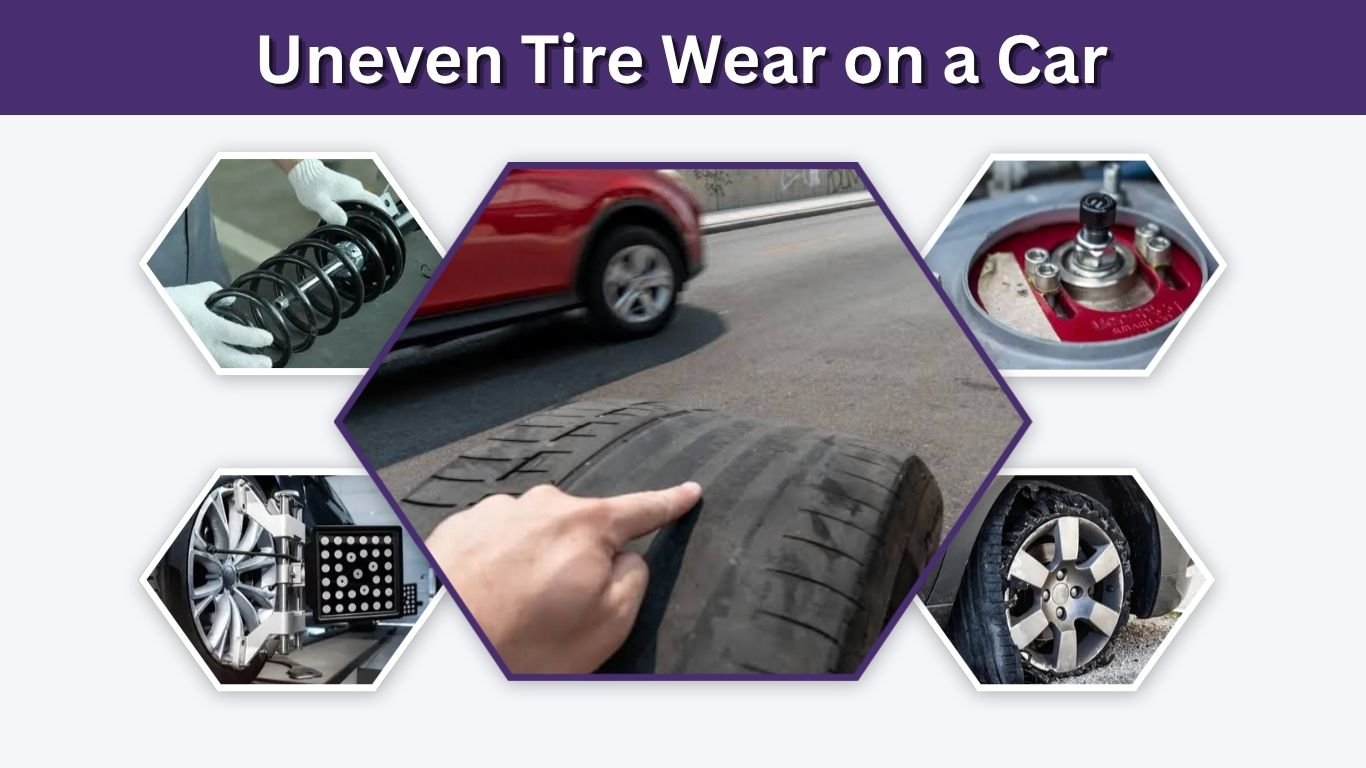
Uneven tire wear on a car is more than a cosmetic problem. It can reduce traction, shorten tire life, increase road noise, and make the vehicle difficult to control. Common causes include incorrect tire pressure, wheel misalignment, worn suspension components, and a lack of tire rotation. Recognizing uneven tire wear patterns early can help you identify the underlying problem before it damages the tires or other vehicle components. Regular inspections and timely repairs are essential for safe, comfortable driving.
What Is Uneven Tire Wear?
Uneven tire wear occurs when one section of a tire loses tread faster than another. Instead of wearing evenly across the entire tread surface, the tire may become worn along one edge, in the center, on both shoulders, or in irregular patches.
A small difference in tread depth may not immediately affect driving. However, severe or continuing wear usually indicates a mechanical, alignment, inflation, or maintenance problem.
Signs of uneven tire wear on a car include:
- One tread edge appearing smoother than the other
- Shallow or missing tread blocks in isolated areas
- Vibrations through the steering wheel
- Increased tire or road noise
- The car pulling toward one side
- Reduced wet-road traction
- Frequent loss of tire pressure
Drivers should inspect all four tires because the wear pattern may differ between the front and rear wheels.
Common Uneven Tire Wear Patterns
A car tire uneven wear pattern can provide important clues about what is wrong. Closely examining the tread surface can help determine whether the problem comes from inflation, alignment, suspension, or wheel balance.
| Tire wear pattern | Likely cause |
| Center tread wear | Excessive tire pressure |
| Wear on both outer edges | Low tire pressure |
| Wear on one edge | Camber or alignment problem |
| Feathered tread blocks | Incorrect toe alignment |
| Cupped or scalloped patches | Worn suspension or wheel imbalance |
| Flat spot in one area | Hard braking, tire skidding, or long-term parking |
| Diagonal wear | Alignment, rotation, or suspension problem |
Center Tread Wear
When the center of the tire wears faster than the shoulders, the tire is often overinflated. Excessive pressure causes the center portion to carry more of the vehicle’s weight.
Always check pressure when the tires are cold and use the pressure recommended on the driver’s door placard rather than the maximum pressure printed on the tire sidewall.
Wear on Both Tire Shoulders
If both outside edges wear faster than the center, the tire may be underinflated. Low pressure allows the outer shoulders to make excessive contact with the road.
Underinflated tires also create additional heat and rolling resistance, which may reduce fuel economy and increase the risk of tire damage.
Wear on One Side of the Tire
Inside- or outside-edge wear is frequently associated with incorrect camber. Camber describes how much the tire tilts inward or outward when viewed from the front of the vehicle.
Excessive negative camber typically wears the inside edge. Excessive positive camber usually wears the outside edge.
Feathering
Feathered tread feels smooth when you run your hand across it in one direction and sharp in the opposite direction. It commonly indicates an incorrect toe setting.
Toe alignment determines whether the front edges of the tires point slightly inward or outward. Even a small error can quickly scrub away tread.
Cupping or Scalloping
Cupped tires develop alternating high and low spots around the tread. This pattern may result from worn shocks, damaged struts, unbalanced wheels, bent components, or loose suspension parts.
Cupping often creates a humming, bouncing, or rhythmic road noise that becomes more noticeable as speed increases.
What Causes Uneven Tire Wear on a Car?
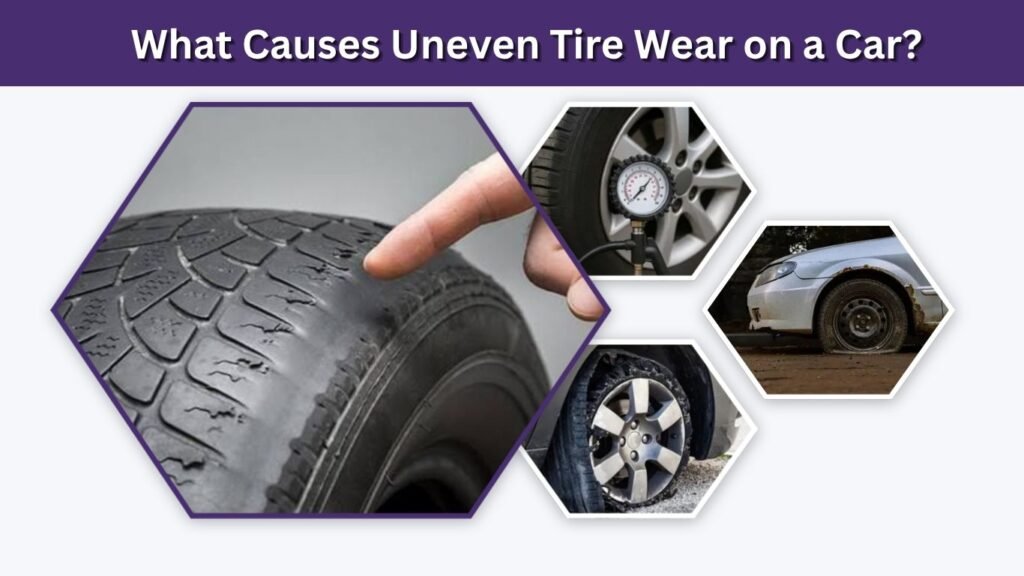
Several maintenance and mechanical problems can cause tires to wear irregularly. In some cases, more than one issue may be present.
Incorrect Tire Pressure
Improper inflation is one of the most common causes. Both excessive and insufficient pressure change the shape of the tire’s contact patch.
Tire pressure can also change with outdoor temperature. Drivers should check it at least once a month and before long trips.
Wheel Misalignment
Wheel alignment controls camber, caster, and toe angles. These angles help the tires remain correctly positioned while the vehicle travels in a straight line and turns.
Alignment may be disturbed by:
- Hitting potholes
- Striking curbs
- Driving on rough roads
- Suspension repairs
- Collisions
- Worn steering components
- Changes to ride height
An alignment problem can destroy a tire’s inner or outer edge while the remaining tread still looks usable.
Failure to Rotate the Tires
Front and rear tires do not experience the same forces. Front tires often handle steering, braking, and, on front-wheel-drive cars, acceleration.
Regular rotation moves tires between different positions so that wear is distributed more evenly. Many vehicles benefit from rotation approximately every 5,000 to 8,000 miles, although the manufacturer’s schedule should take priority.
Worn Suspension Parts
Shocks, struts, ball joints, control arm bushings, tie rods, and wheel bearings help keep the tire firmly positioned against the road.
When these components wear out, the wheel may move excessively or fail to maintain the correct angle. The resulting movement can produce edge wear, cupping, and unpredictable handling.
Unbalanced or Bent Wheels
An unbalanced tire-and-wheel assembly may bounce or vibrate at certain speeds. Over time, this can create irregular patches of tread wear.
Bent wheels, damaged tires, or improperly mounted tires may cause similar symptoms.
Can Uneven Tire Wear Pull a Car to the Left?
Yes, uneven tire wear can pull a car to the left, although alignment, braking, and road conditions can also cause pulling.
A vehicle may drift left when the left and right tires have different tread depths, shapes, pressures, or rolling resistance. A severely worn tire may no longer track in the same direction as the tire on the opposite side.
Possible reasons for a left pull include:
- Low pressure in the left front tire
- Unequal tread depth across the front axle
- Uneven edge wear
- Incorrect wheel alignment
- A sticking left brake caliper
- Damaged suspension components
- Mismatched tire sizes or tread designs
Some roads are crowned for drainage, which can cause a slight drift. Persistent or strong pulling should still be inspected.
Outside Uneven Tire Wear on the Front of a Car
Outside-edge wear on the front tires may result from positive camber, incorrect toe settings, frequent aggressive cornering, low tire pressure, or worn suspension parts.
Because front tires turn and carry substantial braking loads, their outer shoulders may wear faster than the rear tires. However, rapid or extreme wear on only one side usually indicates a problem.
A technician may need to inspect the alignment, ball joints, tie rods, control arm bushings, and wheel bearings before performing an alignment.
Uneven Tire Wear on a Lowered Car
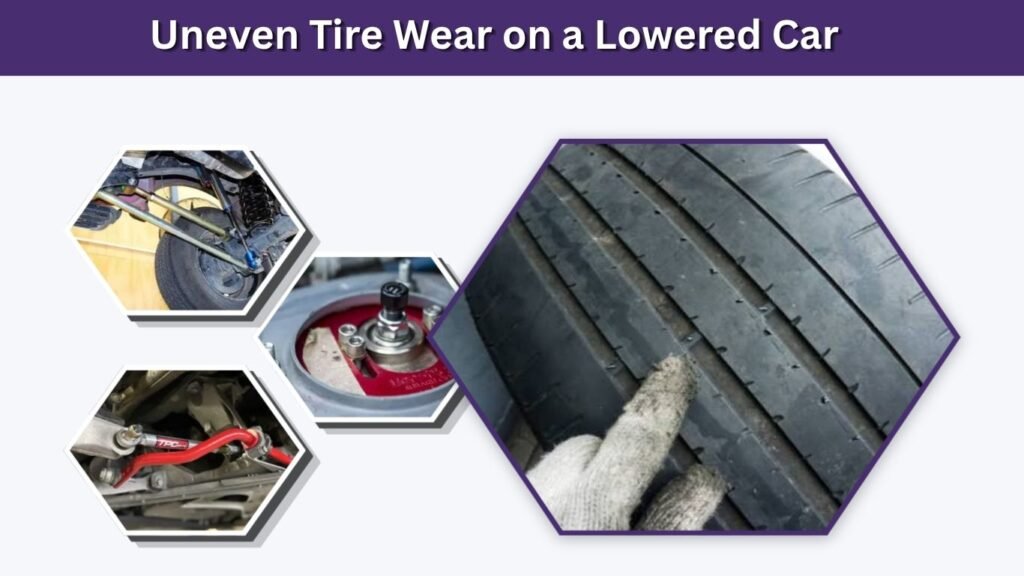
Lowering a car changes suspension geometry. Depending on the design and the amount of lowering, the wheels may develop excessive negative camber or incorrect toe.
Negative camber alone does not always destroy tires quickly. A combination of excessive camber and incorrect toe is often responsible for severe inside-edge wear.
Owners of lowered vehicles may need:
- Adjustable control arms
- Camber plates
- Adjustable toe links
- Correctly sized wheels and tires
- A performance alignment
- Frequent tread inspections
An alignment should be performed after installing lowering springs, coilovers, adjustable suspension parts, or different wheel sizes.
Car Damage From Uneven Tire Wear
Ignoring irregular wear may affect more than the tires. Continued driving can increase stress on suspension and steering components, especially when the original cause is mechanical.
| Possible problem | How uneven wear contributes |
| Reduced traction | Worn sections cannot grip effectively |
| Longer stopping distance | Less usable tread contacts the road |
| Hydroplaning | Shallow tread cannot remove water efficiently |
| Steering vibration | Irregular tread creates inconsistent road contact |
| Suspension stress | Vibration and bouncing increase component movement |
| Tire failure | Thin tread is more vulnerable to damage and heat |
| Poor fuel economy | Drag, low pressure, and alignment resistance increase |
Uneven tires may also interfere with traction-control and all-wheel-drive systems when tread depth varies significantly between wheels.
How to Check Tires for Uneven Wear
Inspecting tires regularly helps identify problems before the tread reaches an unsafe depth.
Measure Several Tread Locations
Use a tread-depth gauge to measure the inside edge, center, and outside edge of each tire. Measuring only the visible outer tread may miss dangerous inside wear.
Compare the readings across the tire and between tires on the same axle.
Look and Feel Across the Tread
Run your hand carefully across the tread surface. Feel for sharp edges, dips, raised blocks, flat spots, exposed cords, cracks, or bulges.
Turn the steering wheel fully to one side to make the inner tread of the front tires easier to inspect.
Check Tire Pressure
Measure pressure with an accurate gauge when the tires are cold. Adjust each tire to the vehicle manufacturer’s recommendation.
A tire that repeatedly loses pressure may have a puncture, leaking valve, damaged wheel, or poor bead seal.
How to Fix Uneven Tire Wear
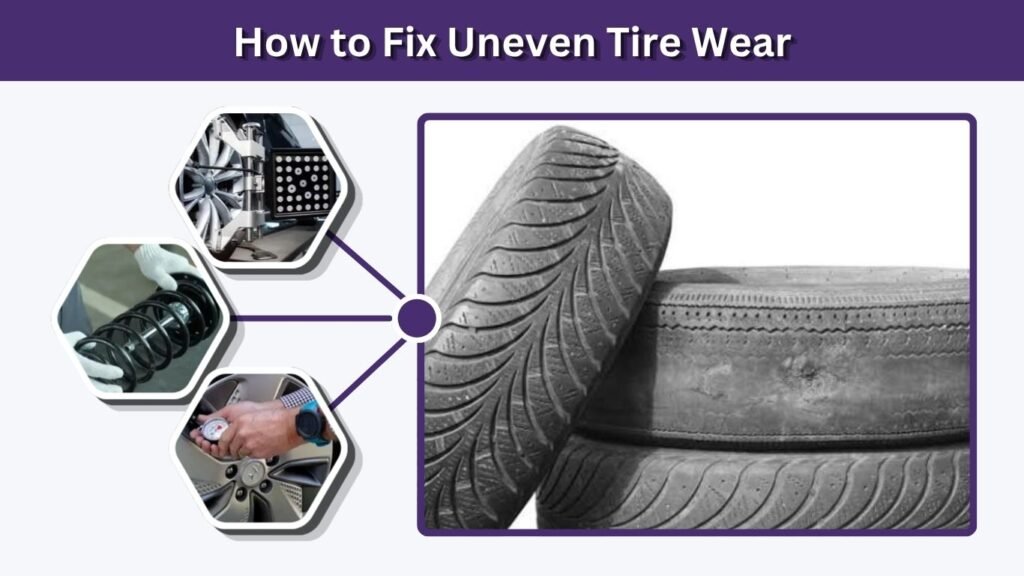
The correct repair depends on the wear pattern and its underlying cause.
Common solutions include:
- Correcting tire pressure
- Rotating the tires
- Balancing the wheels
- Performing a four-wheel alignment
- Replacing worn shocks or struts
- Repairing steering and suspension components
- Replacing damaged or excessively worn tires
An alignment will not restore tread that has already worn away. If the tire is severely worn, exposing cords, cracked, bulging, or below the legal tread limit, it should be replaced.
Tires with different tread depths may also need to be replaced in pairs or as a complete set, especially on certain all-wheel-drive vehicles.
How to Prevent Uneven Tire Wear
Preventive maintenance is usually less expensive than replacing tires early.
Check pressure monthly, rotate tires according to the maintenance schedule, and inspect the tread every few weeks. Have the alignment checked after hitting a serious pothole, installing suspension components, or noticing steering changes.
Avoid overloading the vehicle and use tires with the correct size, load rating, and speed rating. Drivers should also address vibrations, pulling, clunking noises, and loose steering as soon as possible.
FAQs
Is uneven tire wear dangerous?
Yes. Uneven wear can reduce traction, increase stopping distance, and make steering less predictable. A badly worn inner edge may expose tire cords even when the outer tread looks normal. Severe wear also increases the possibility of a puncture or tire failure.
Can I continue driving with uneven tire wear?
Minor wear may allow limited driving while arranging an inspection, but severe wear should be addressed immediately. Do not continue driving if cords are visible, the tire has a bulge, the vehicle vibrates strongly, or the tread is below the safe limit.
Will an alignment fix uneven tire wear?
An alignment can correct the wheel angles that caused the wear, but it cannot replace lost tread. The tires may still need replacement if they are badly worn, noisy, damaged, or unable to provide adequate traction.
How quickly can bad alignment wear out tires?
Severe alignment problems can noticeably damage tires within a few hundred or thousand miles. The exact rate depends on the alignment angle, driving speed, vehicle weight, road conditions, tire design, and whether suspension parts are damaged.
Should unevenly worn tires be replaced in pairs?
Replacing tires in pairs is often recommended so both tires on the same axle have similar traction and tread depth. All-wheel-drive vehicles may require four closely matched tires to avoid placing unnecessary stress on the drivetrain.