
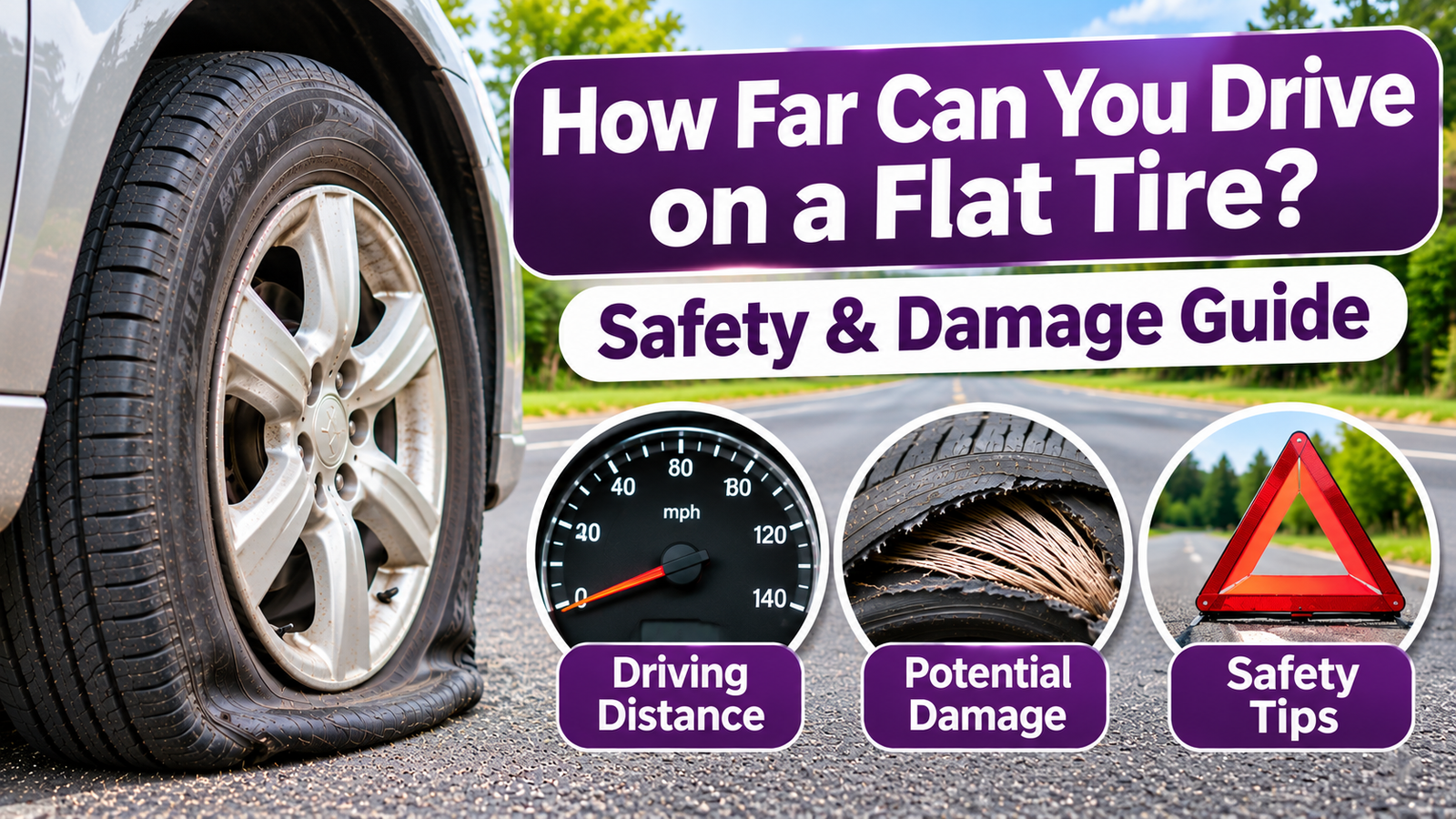
A flat tire can leave you wondering whether you can drive a few miles to the nearest repair shop or need to stop immediately. The distance you can travel depends on the tire type, air pressure, road conditions, and vehicle weight. While some run-flat tires allow limited driving after losing pressure, conventional tires can suffer serious damage within a short distance. Understanding how far you can drive on a flat tire, the risks involved, and the safest emergency steps can help you avoid expensive repairs and dangerous situations.
How Far Can You Drive on a Flat Tire?
You should not drive any unnecessary distance on a completely flat conventional tire. Even a few hundred feet can cause significant damage to the tire’s sidewall and wheel rim. There is no guaranteed safe driving distance because the damage depends on the tire’s condition, vehicle weight, speed, and road surface.
When a tire loses all its air pressure, it can no longer properly support the vehicle. The sidewalls collapse under the vehicle’s weight, creating friction, excessive bending, and heat.
If you experience a flat tire while driving, reduce your speed gradually and stop at the nearest safe location. Do not continue toward a repair shop unless your vehicle has suitable run-flat tires and you are following the manufacturer’s instructions.
Flat Tire Driving Distance by Tire Type
| Tire Condition | Recommended Driving Distance |
|---|---|
| Completely flat conventional tire | No unnecessary driving |
| Severely underinflated conventional tire | Stop safely and address the problem |
| Slow puncture with adequate pressure | Limited travel may be possible after assessment |
| Run-flat tire | Often up to 50 miles, depending on specifications |
| Temporary spare tire | Commonly up to 50 miles, depending on manufacturer |
A temporary spare is not a completely flat tire. It must be properly inflated and used within its specified speed, distance, and load limits.
Can You Drive 1 Mile on a Flat Tire?
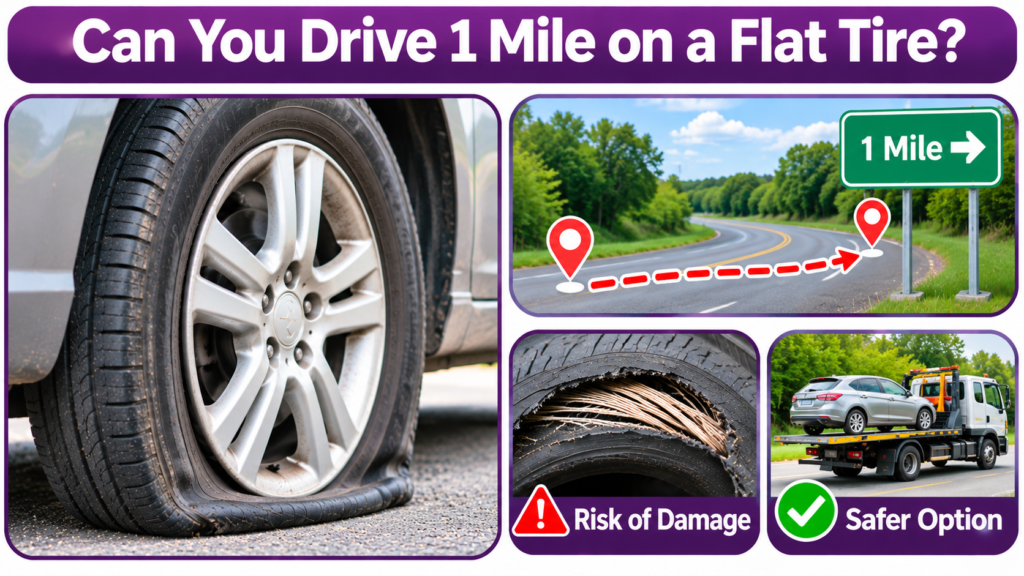
Driving one mile on a completely flat conventional tire is not recommended. Although your vehicle may physically move, the tire can experience serious damage before reaching your destination.
Without adequate air pressure, the tire’s sidewalls repeatedly compress between the wheel and road. This may damage internal cords, weaken the rubber, and make the tire impossible to repair.
What Happens If You Drive One Mile?
Several problems can occur when driving one mile on a flat tire:
- Sidewall damage: Excessive bending can weaken or destroy the tire’s internal structure.
- Rim damage: The metal wheel may contact the pavement and become scratched, bent, or cracked.
- Poor handling: The vehicle may pull toward the damaged tire.
- Increased heat: Friction and repeated tire deformation can create excessive heat.
- Tire separation: The tire may partially separate from the wheel, creating a dangerous situation.
If a repair shop is only one mile away, using roadside assistance is generally safer than attempting to drive there.
Can You Drive 5 Miles on a Flat Tire?
Driving five miles on a completely flat conventional tire creates a substantial risk of severe tire and wheel damage. The tire may become permanently unusable long before you reach the five-mile mark.
Even when the vehicle seems controllable, the tire may be experiencing structural damage that is not visible from the driver’s seat.
Why Driving Five Miles Is Dangerous
Driving this distance can create several mechanical and safety problems.
The tire’s internal structure may deteriorate from excessive flexing. As the sidewalls lose their ability to support the vehicle, the wheel can move closer to the road surface and experience direct impacts.
Steering and braking may also become unpredictable. The damaged tire can change how the vehicle responds during turns, emergency stops, and uneven road conditions.
Rather than continuing for five miles, stop in a safe place and arrange a tire replacement or towing service.
Can You Drive 10 Miles on a Flat Tire?
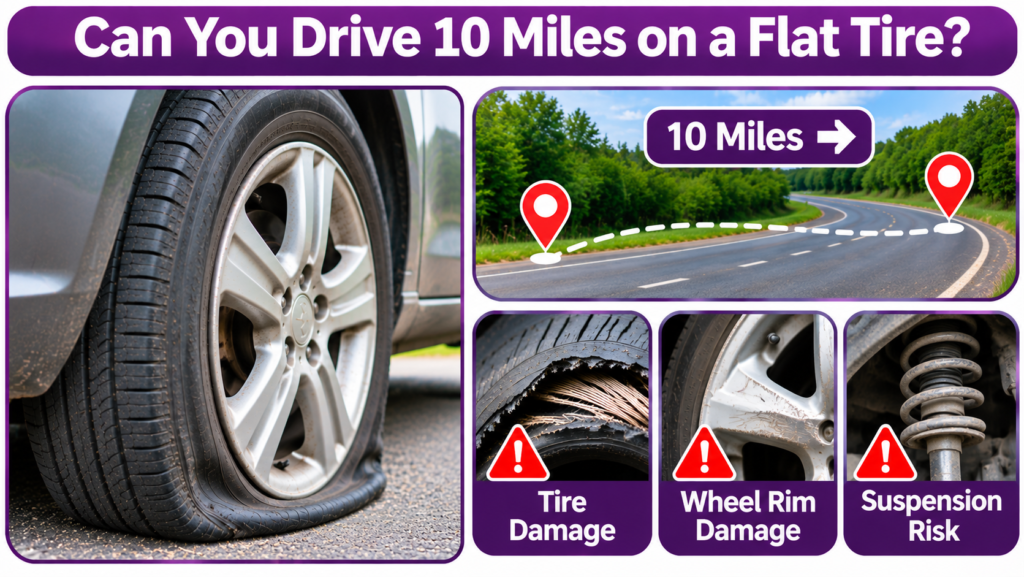
Driving ten miles on a completely flat conventional tire is extremely unsafe and should be avoided. At this distance, the tire may be destroyed, and the wheel rim may sustain expensive damage.
The longer a vehicle travels on a flat tire, the greater the opportunity for additional mechanical problems.
Potential Damage From Driving 10 Miles
- Destroyed tire: Severe sidewall damage may make replacement unavoidable.
- Bent wheel rim: Direct contact with the road can deform the wheel.
- Suspension stress: Abnormal wheel movement and road impacts may affect suspension components.
- Steering instability: The vehicle may become increasingly difficult to control.
- Reduced braking performance: Uneven traction can affect braking stability.
- Higher repair costs: Damage may extend beyond the tire itself.
Even when the nearest service station is ten miles away, towing is a safer option than continuing on a completely flat tire.
How Far Can You Drive on a Run-Flat Tire?
Run-flat tires are designed to provide temporary mobility after a significant loss of air pressure. Their reinforced construction allows certain models to support the vehicle for a limited distance without normal inflation.
Many self-supporting run-flat tires are rated for approximately 50 miles at speeds not exceeding 50 mph after losing pressure. However, actual limits vary by tire manufacturer, vehicle load, road conditions, and tire condition.
Run-Flat Tire Driving Limits
Run-flat tires have specific operating restrictions:
- Maximum distance: Often approximately 50 miles after pressure loss.
- Maximum speed: Commonly 50 mph, depending on tire specifications.
- Vehicle compatibility: The tires must be appropriate for the vehicle.
- Tire condition: Existing damage may reduce their emergency driving capability.
- Repair requirements: Some manufacturers prohibit repairing run-flat tires after zero-pressure operation.
Always consult your vehicle manual and the tire manufacturer’s instructions.
A run-flat tire does not provide unlimited driving capability. Its emergency mobility feature is intended to help you reach a safe location or repair facility.
How Fast Can You Drive on a Flat Tire?
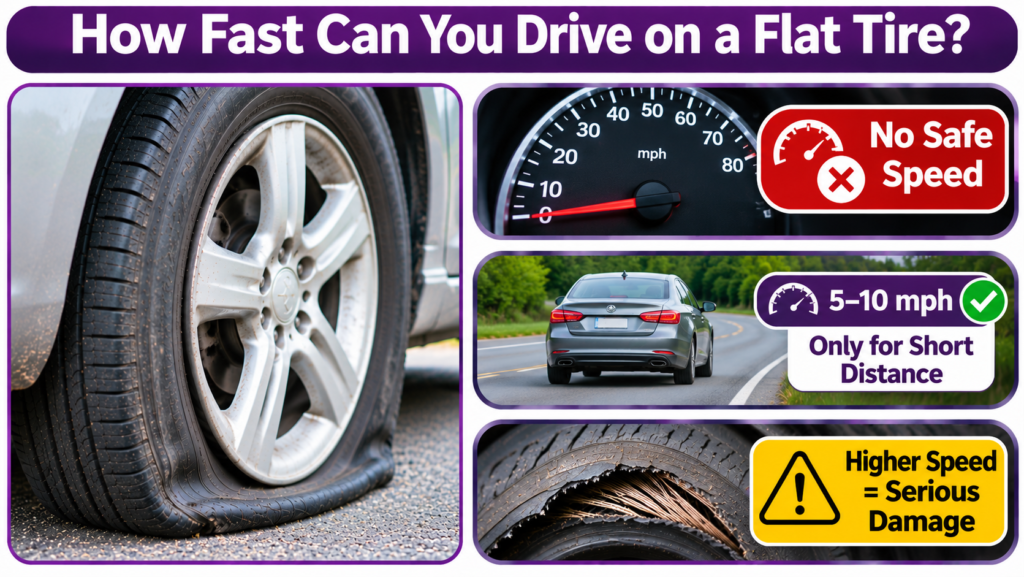
There is no safe recommended driving speed for a completely flat conventional tire. Driving slowly does not prevent sidewall damage or eliminate the risk of losing control.
Even at 5–10 mph, the tire may deform severely under the vehicle’s weight.
If a flat tire develops while driving at highway speed, avoid sudden braking or sharp steering. Gradually release the accelerator, maintain control, and move toward a safe stopping location.
Is Driving 20 MPH on a Flat Tire Safe?
No. Driving at 20 mph on a completely flat conventional tire is dangerous.
The tire’s sidewalls may collapse repeatedly, and the wheel rim can experience significant stress. Steering response may also become unpredictable, especially during turns.
If movement is absolutely necessary to escape immediate danger, travel only the shortest distance required to reach safety.
What Happens When You Drive Too Far on a Flat Tire?
Continuing to drive after a tire loses pressure can damage more than the tire itself. A flat tire changes how the vehicle’s weight is supported and how the wheel interacts with the road.
The severity of the damage depends on driving distance, speed, vehicle weight, and road conditions.
Common Types of Vehicle Damage
- Tire sidewall failure: Excessive flexing can damage internal cords and rubber layers.
- Wheel rim damage: The rim may become scratched, bent, or cracked.
- Wheel alignment problems: Severe impacts while driving flat can affect alignment.
- Suspension damage: Continued driving over uneven surfaces may place additional stress on suspension components.
- Tire pressure sensor damage: Tire movement inside the wheel may damage the TPMS sensor in some situations.
- Loss of vehicle control: Reduced traction and unpredictable steering increase accident risks.
Stopping promptly can help prevent a repairable puncture from becoming a much more expensive problem.
What Should You Do If You Have a Flat Tire While Driving?
A flat tire requires immediate attention, but it is important to respond calmly. Sudden steering or braking can make an already unstable vehicle harder to control.
Your priority should be reaching a safe stopping location without creating additional danger.
Steps to Handle a Flat Tire Safely
- Hold the steering wheel firmly: Maintain control if the vehicle begins pulling toward one side.
- Release the accelerator gradually: Allow the vehicle to slow down without sudden braking.
- Avoid sharp turns: Sudden steering movements may worsen instability.
- Activate hazard lights: Make your vehicle more visible to surrounding drivers.
- Find a safe stopping location: Choose a parking area, emergency stopping zone, or sufficiently wide shoulder.
- Park securely: Stop on stable ground and engage the parking brake.
- Check the tire when safe: Look for visible damage without exposing yourself to moving traffic.
- Request assistance: Use a spare tire or contact a roadside assistance provider.
If the vehicle stops in a dangerous traffic location, follow local emergency procedures rather than attempting an unsafe roadside tire change.
Can You Repair a Tire After Driving on It Flat?
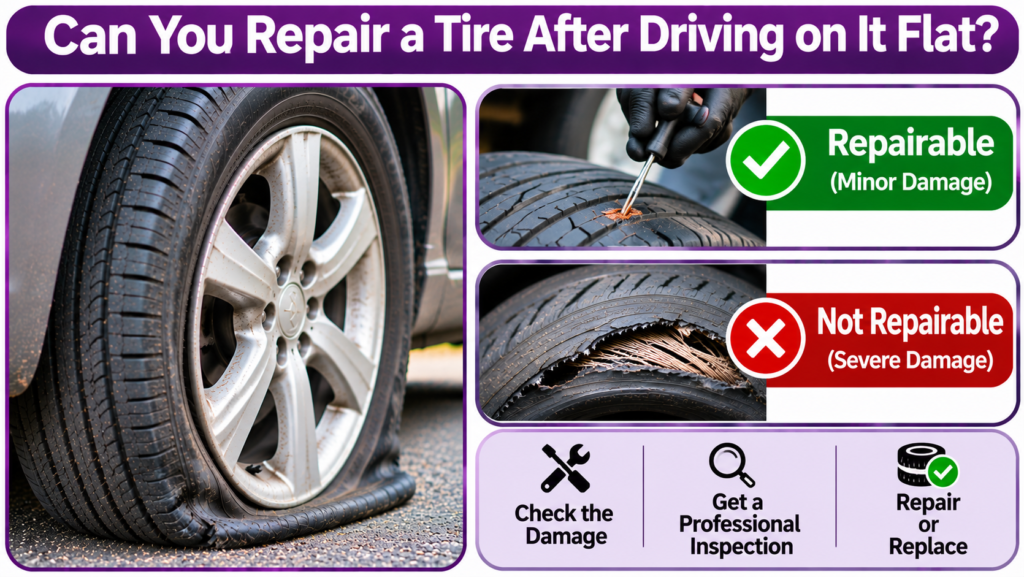
A tire may be repairable after a puncture, but driving on it while severely underinflated or completely flat can make repair impossible.
When a tire operates without adequate pressure, its internal components experience excessive flexing and heat. This can damage the tire even if the outside appears relatively normal.
When Should You Replace the Tire?
A tire generally requires replacement if it has:
- Sidewall punctures, cuts, bulges, or structural damage.
- Internal damage caused by driving without sufficient air pressure.
- Exposed cords or significant rubber deterioration.
- A puncture outside the repairable tread area.
- Damage larger than accepted tire repair limits.
- Excessive tread wear or other unsafe conditions.
A qualified tire technician should remove the tire from the wheel to inspect its internal structure.
If the damage is limited to a small puncture in the repairable tread area, a proper combination patch-and-plug repair may be possible.
How to Prevent Flat Tires on the Road
Preventing flat tires begins with routine maintenance and careful driving. Although unexpected punctures cannot always be avoided, properly maintained tires are less likely to experience pressure-related failures.
Check tire pressure at least monthly and before long trips. Always use the manufacturer’s recommended cold tire pressure rather than the maximum pressure printed on the tire sidewall.
Inspect the tread and sidewalls for visible damage, uneven wear, embedded objects, and bulges.
Avoid potholes, sharp debris, and overloading your vehicle. Replace excessively worn or damaged tires before they become unsafe.
Regular inspections and proper inflation can improve tire life, handling, and overall road safety.
FAQs
1. How Far Can You Drive on a Completely Flat Tire?
There is no guaranteed safe distance for driving on a completely flat conventional tire. Even traveling a few hundred feet may cause significant sidewall or rim damage. Stop at the nearest safe location and arrange roadside assistance instead of attempting to reach a repair shop.
2. Can You Drive 2 Miles on a Flat Tire?
Driving two miles on a completely flat conventional tire is not recommended. The tire’s internal structure may become permanently damaged, and the wheel rim may contact the road. If you cannot safely replace the tire, request roadside assistance or towing.
3. How Far Can You Drive on a Flat Tire Without Damaging the Rim?
There is no guaranteed distance you can drive on a completely flat tire without damaging the rim. Wheel damage can begin almost immediately, depending on road conditions and vehicle weight. Stopping as soon as safely possible offers the best protection.
4. Can You Drive on a Flat Tire to the Nearest Gas Station?
You should not drive on a completely flat conventional tire to a gas station, even when it is nearby. Continuing to drive may destroy the tire and damage the wheel. Changing to a suitable spare or calling roadside assistance is safer.
5. How Far Can You Drive on a Flat Tire With a Nail?
The distance depends on whether the tire still holds adequate air pressure. A nail may cause a slow leak, but continued driving can become dangerous as pressure decreases. If the tire is flat or losing pressure rapidly, stop and arrange professional repair.