
Have you noticed the letters XL printed on your tire’s sidewall and wondered what they mean? XL stands for Extra Load, indicating a tire designed to carry a higher maximum load than a standard tire of the same size. These tires are commonly used on SUVs, electric vehicles, and certain performance cars that require additional load capacity. However, XL tires also have specific inflation requirements and performance characteristics. Understanding what XL means on a tire helps you choose the correct replacement, interpret tire ratings, and maintain safe driving conditions.
What Does XL Mean on a Tire?
XL stands for Extra Load, a designation used for reinforced passenger vehicle tires with increased load-carrying capacity. Compared with standard-load tires of identical dimensions, XL tires are designed to support greater weight at higher inflation pressures. The XL marking normally appears near the tire size and service description, helping drivers identify tires suitable for vehicles requiring higher load ratings.
What Is an Extra Load Tire?
An Extra Load tire has a construction designed to withstand the higher inflation pressures needed to achieve its increased load rating.
Manufacturers may use reinforced internal components, including stronger casing materials or other structural improvements.
Despite the name, Extra Load does not mean that the tire is physically larger than a standard tire.
For example, two tires labeled 225/45R17 may have identical nominal dimensions, even though one is classified as Standard Load and the other as Extra Load.
Their load indexes and applicable inflation requirements distinguish their capabilities.
What Does XL Mean on a Tire Size?
The XL designation normally appears after the load index and speed rating.
Consider this example: 225/45R17 94W XL.
- 225: Tire width in millimeters.
- 45: Sidewall aspect ratio.
- R: Radial construction.
- 17: Wheel diameter in inches.
- 94: Load index, equivalent to 670 kilograms per tire.
- W: Speed rating of up to 168 mph.
- XL: Extra Load classification.
The XL marking identifies the load category rather than changing the measurements shown in the tire size.
How Do XL Tires Work?
XL tires achieve their higher load ratings through construction designed for additional inflation pressure. Tire load capacity depends on dimensions, construction, and operating pressure. An Extra Load tire can carry more weight than a standard-load equivalent when inflated to the pressure needed for its higher rating. However, this does not mean that every XL tire automatically supports more weight at the same pressure.
Reinforced Tire Construction
XL tires are designed to manage higher inflation pressures and the stresses associated with increased loading.
Their construction can provide additional structural support, particularly on heavier vehicles or vehicles carrying substantial loads.
Depending on the tire model, this design may also influence steering response, ride firmness, and handling stability.
However, an XL marking alone does not guarantee better traction, longer tread life, or greater puncture resistance. Those characteristics depend on the tire’s overall engineering and materials.
XL Tire Load Capacity
The load index is the number that indicates a tire’s rated maximum load under specified conditions.
For example, consider two tires with the same dimensions:
- 205/55R16 91V SL: Load index 91, rated for 615 kg.
- 205/55R16 94V XL: Load index 94, rated for 670 kg.
The XL version has a higher maximum load rating, provided the appropriate inflation requirements are satisfied.
This additional capacity can be useful for vehicles designed to operate with higher tire loads. It does not increase the vehicle manufacturer’s permitted total weight.
Do XL Tires Need Higher Air Pressure?
XL tires generally require higher inflation pressure than comparable Standard Load tires to achieve their additional maximum load capacity.
For traditional P-metric tire standards, standard-load maximum load ratings are commonly based on 35 PSI, while Extra Load ratings are based on 41 PSI. Some newer standards use 36 and 42 PSI instead.
These figures describe load-rating reference pressures, not universal everyday inflation recommendations.
Always consult the vehicle’s tire information placard or owner’s manual for the appropriate cold inflation pressure. If changing tire specifications, confirm the correct pressure with the vehicle or tire manufacturer.
XL vs. SL Tires: What’s the Difference?
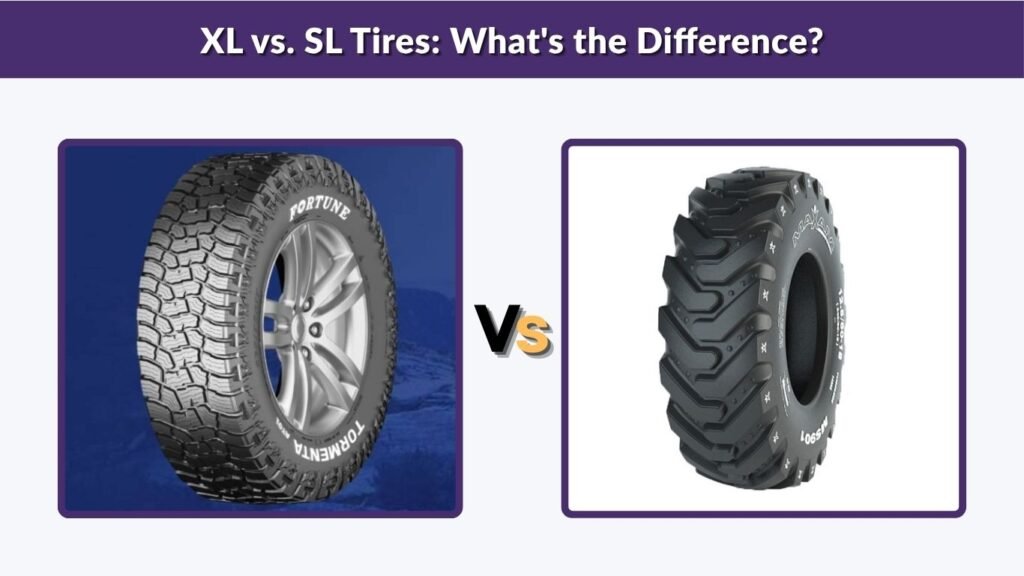
XL and SL are two common passenger tire load classifications. SL stands for Standard Load, while XL stands for Extra Load. Both can be available in identical tire sizes, but their maximum rated load capacities differ. Selecting between them requires understanding the vehicle’s specifications rather than assuming that the tire with the higher rating is automatically the better option.
XL vs. Standard Load Comparison
| Feature | XL Tire | SL Tire |
| Full meaning | Extra Load | Standard Load |
| Maximum load rating | Higher for the same size | Standard |
| Construction | Designed for higher load pressures | Standard construction |
| Rated load pressure | Higher | Lower |
| Ride comfort | May feel firmer | May feel softer |
| Cost | Often more expensive | Often less expensive |
| Common applications | Certain SUVs, EVs, performance cars | Many passenger vehicles |
Are XL Tires Better Than Regular Tires?
XL tires are better suited to vehicles that require their higher load capacity.
For heavier vehicles, the reinforced design may offer improved support under demanding loading conditions.
However, standard-load tires can be perfectly suitable for vehicles designed to use them.
Installing an XL tire does not automatically improve braking, fuel economy, or tread life.
The best choice depends on the vehicle’s original specifications, intended use, tire model, and recommended inflation pressure.
What Do 100W XL, 101W XL, and Other Ratings Mean?
Many XL tire markings combine numbers and letters before the Extra Load designation. The number represents the load index, while the letter identifies the speed rating. XL then confirms the tire’s load classification. Understanding these combinations helps drivers interpret sidewall information and determine whether a particular replacement tire meets their vehicle’s required specifications.
What Does 100W XL Mean on a Tire?
A marking of 100W XL contains three separate pieces of information.
The number 100 indicates a maximum rated load of 800 kilograms, or approximately 1,764 pounds, per tire under specified conditions.
The letter W indicates a speed rating of up to 168 mph (270 km/h).
Finally, XL means Extra Load.
The marking does not indicate tire width, wheel diameter, or recommended operating pressure. Those details must be checked separately.
Common XL Tire Ratings Explained
| Tire Rating | Maximum Load per Tire | Speed Rating |
| 94V XL | 670 kg | 149 mph |
| 95W XL | 690 kg | 168 mph |
| 98W XL | 750 kg | 168 mph |
| 100W XL | 800 kg | 168 mph |
| 101W XL | 825 kg | 168 mph |
| 103W XL | 875 kg | 168 mph |
| 105V XL | 925 kg | 149 mph |
These are standardized load-index and speed-rating values. Each combination must also be available in an appropriate tire size and approved for the vehicle.
The speed rating describes tested capability, not a recommendation to drive at that speed.
What Does XL BSW Mean on a Tire?
If a tire description includes XL BSW, the two abbreviations have different meanings.
XL means Extra Load, while BSW means Black Sidewall.
BSW describes the tire’s sidewall appearance and has no effect on its load rating.
Similarly, the letters RF or the word Reinforced may be used to identify Extra Load tires. They should not be confused with a tire manufacturer’s separate run-flat markings.
Do You Need XL Tires for Your Vehicle?

Not every vehicle requires Extra Load tires. XL tires are commonly specified for vehicles with greater weight or particular performance requirements. Choosing them should depend on the manufacturer’s recommended size, load index, and tire classification. Understanding when XL tires are necessary helps drivers avoid incorrect substitutions and prevents unnecessary changes to tire pressure or vehicle handling.
Which Vehicles Commonly Use XL Tires?
XL tires may be specified for several vehicle categories:
- SUVs: Some models require higher load ratings because of their weight.
- Electric vehicles: Heavy battery packs can increase load requirements.
- Performance cars: Certain models use XL tires to meet handling and loading specifications.
- Passenger cars: Some sedans and crossovers also require Extra Load tires.
The vehicle category alone does not determine the correct tire. Always verify the exact manufacturer specification.
Can You Replace XL Tires With Standard Tires?
If your vehicle originally requires XL tires, replacing them with Standard Load tires may reduce available load capacity.
Even when both tires share the same dimensions, the standard tire may not meet the required load index or inflation conditions.
Avoid changing to a lower load classification without confirmation from the vehicle manufacturer or a qualified tire professional.
Can You Use XL Tires Instead of Standard Tires?
It may be possible to install XL tires on a vehicle originally fitted with Standard Load tires, provided the replacement meets the required size, load, speed, and fitment specifications.
However, the additional load capacity does not increase the vehicle’s legal weight limits or automatically improve performance.
Follow approved inflation guidance rather than increasing tire pressure simply because the replacement is marked XL.
FAQs
XL tire markings can be confusing because they appear alongside several numbers and letters describing tire performance. Drivers also commonly misunderstand the relationship between Extra Load tires, inflation pressure, and other specialty tire designs. The following answers address some of the most frequently asked questions about XL tires and help clarify when their higher load capacity is useful.
1. Does XL Mean Extra Large on a Tire?
No. XL means Extra Load, not Extra Large. It indicates an increased load-carrying rating rather than a larger tire diameter or width.
2. Are XL Tires Run-Flat Tires?
No. XL and run-flat are different designations. XL identifies increased load capability, while run-flat technology allows limited continued driving after certain pressure-loss events. Some tires may have both features, but neither marking automatically implies the other.
3. Do XL Tires Last Longer Than Regular Tires?
Not necessarily. Tire longevity depends on tread compound, road conditions, inflation, driving habits, alignment, and maintenance. XL construction alone does not guarantee longer tread life.
4. What Does XL Mean on a Tire Rating?
XL indicates that the tire belongs to the Extra Load category. It works alongside the numerical load index, which specifies maximum rated weight capacity, and the letter-based speed rating.
5. Are XL Tires Good for Everyday Driving?
Yes, when they are appropriate for the vehicle. Many cars and SUVs use XL tires daily. They can provide the load capacity required by heavier vehicles, but they offer no universal advantage when standard-load tires already meet the manufacturer’s requirements.