
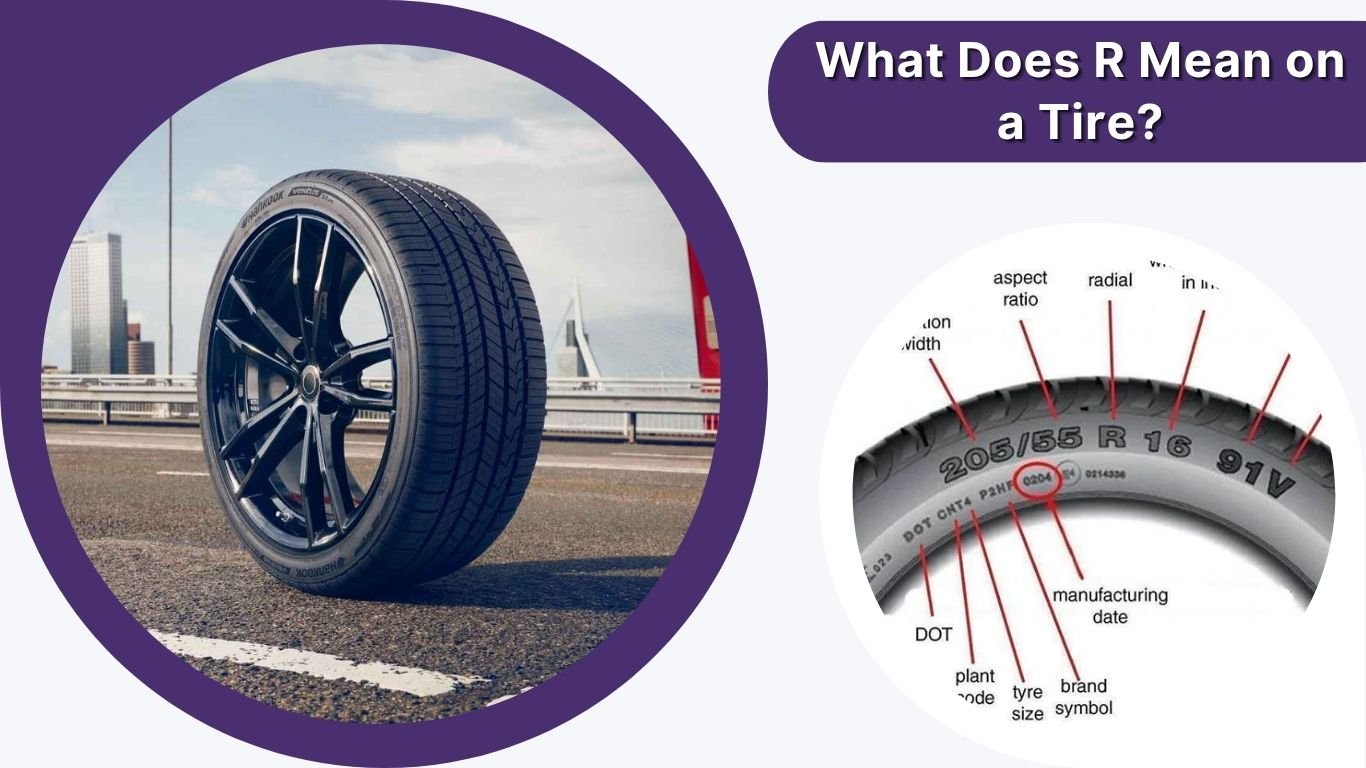
When checking your vehicle’s tires, you may notice the letter R between the numbers printed on the sidewall. But what does R mean on a tire, and does it affect performance? The letter R stands for Radial, describing how the tire’s internal reinforcing cords are arranged. Radial tires are widely used on modern cars, SUVs, and trucks because of their handling, comfort, and efficiency. Understanding this marking, along with nearby numbers and letters, helps you identify the correct tire size and specifications for your vehicle.
What Does R Mean on a Tire?
The letter R on a tire stands for Radial, referring to the tire’s internal construction. Radial tires feature reinforcing cords arranged approximately perpendicular to the direction of travel, extending from bead to bead. This design allows the sidewalls to flex while supporting a relatively stable tread area. Radial construction is standard on most modern passenger vehicles.
What Does Radial Mean on a Tire?
Radial describes the arrangement of reinforcing cords inside the tire. These cords extend across the tire from one bead to the other at approximately 90 degrees to the direction of travel.
Most radial tires also contain stabilizing belts beneath the tread. This construction helps separate sidewall flexibility from tread stability, improving handling and everyday driving comfort.
Where Is the Letter R Located?
The letter R usually appears between the tire’s aspect ratio and wheel diameter.
For example, in 225/65R17, the R appears between 65 and 17. It indicates radial construction rather than a specific tire size, speed capability, or manufacturer.
You can find this marking molded into the tire’s sidewall.
How to Read R on a Tire Size
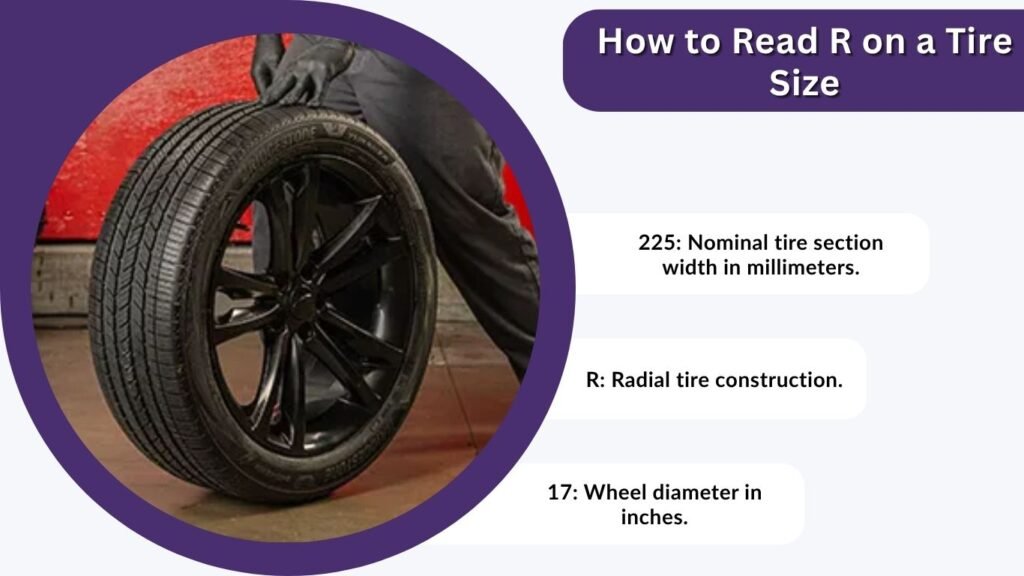
Tire sidewalls contain combinations of numbers and letters that explain important specifications. The R marking forms part of a standardized tire-size code, appearing alongside measurements for tire width, sidewall proportions, and wheel diameter. Understanding these numbers prevents confusion when comparing replacement tires and helps drivers identify the correct dimensions for their vehicles.
Understanding 225/65R17 Tire Size
Consider the tire marking 225/65R17 102H. Each part provides specific information:
- 225: Nominal tire section width in millimeters.
- 65: Aspect ratio, meaning sidewall height equals 65% of the tire’s section width.
- R: Radial tire construction.
- 17: Wheel diameter in inches.
- 102: Load index representing the tire’s rated weight capacity.
- H: Speed rating indicating a maximum rated speed of 130 mph (210 km/h).
These markings help drivers identify tire dimensions and operating capabilities.
What Does R17 or R20 Mean on a Tire?
R17 means the tire has radial construction and fits a 17-inch diameter wheel. Similarly, R20 indicates radial construction and a 20-inch wheel diameter.
The numbers after R do not measure the tire’s total outside diameter.
For example, a 265/70R17 tire and a 265/70R20 tire have different wheel requirements despite sharing the same width and aspect ratio.
Why Is Radial Tire Construction Important?
Radial construction influences several aspects of tire performance, including steering response, ride comfort, and rolling resistance. Unlike traditional bias-ply construction, radial tires allow the sidewalls and tread to perform somewhat independently. This structural difference has made radial tires the preferred choice for modern passenger vehicles, although specialized applications may still benefit from other construction types.
Main Benefits of Radial Tires
- Improved comfort: Flexible sidewalls help absorb minor road irregularities.
- Better tread stability: Reinforcing belts help maintain a consistent tread contact area.
- Lower rolling resistance: Radial designs generally offer efficiency advantages over comparable bias-ply tires.
- Longer tread life: Properly designed radial tires often provide more even wear under suitable conditions.
- Highway performance: Radial construction supports stable handling during normal road travel.
Radial Tires vs. Bias-Ply Tires
Radial tires use cords extending approximately perpendicular to the direction of travel. Bias-ply tires use reinforcing layers that cross diagonally.
Bias-ply construction creates a different relationship between the tread and sidewalls, often producing a stiffer overall casing.
Although radial tires dominate passenger vehicle applications, bias-ply designs remain useful in certain agricultural, industrial, and specialized applications.
Neither construction should be substituted without confirming vehicle and tire compatibility.
What Do Numbers Around R Mean on a Tire?

The numbers surrounding R have different meanings depending on where they appear. Numbers before R commonly indicate tire width and aspect ratio, while numbers immediately after R specify the wheel diameter. However, an R appearing within the service description can represent a speed rating instead. Understanding its position helps distinguish construction markings from performance ratings.
Common R Tire Markings Explained
- 55R: In a size such as 205/55R16, 55 is the aspect ratio, while R means radial construction.
- 60R: In 225/60R17, 60 indicates the sidewall’s proportional height, followed by radial construction.
- 70R: In 265/70R17, 70 represents the aspect ratio, not tire width.
- R17: Indicates radial construction for a 17-inch wheel.
- R20: Indicates radial construction for a 20-inch wheel.
- 109R: When appearing as a service description, 109 is the load index and R is the speed rating.
- 125R: When used as a service description, 125 identifies the load index and R identifies the speed rating.
Does R Also Mean a Tire Speed Rating?
Yes, R can also represent a speed rating, depending on its position.
An R speed rating corresponds to a maximum rated speed of 106 mph (170 km/h) under specified operating conditions.
For example, in a tire marked 265/75R16 123/120R, the first R identifies radial construction, while the final R identifies the speed rating.
These two meanings should not be confused.
What Is the Difference Between R, R/T, and PR?
Tire markings sometimes contain similar letters that describe completely different characteristics. R commonly identifies radial construction, while R/T is associated with a particular off-road tread category. PR, meanwhile, relates to a tire’s ply rating. Recognizing these differences is important because markings describing construction, intended terrain, and load capability should not be interpreted interchangeably.
Common Tire Abbreviations
- R: Radial construction when appearing within the tire-size designation.
- R/T: Rugged Terrain, a category of tires generally positioned between all-terrain and mud-terrain designs.
- PR: Ply Rating, a traditional designation associated with tire load-carrying strength.
- 10PR: Ten-ply rating, which does not necessarily mean the tire physically contains ten plies.
- ZR: A radial tire designation historically associated with high-speed tire capabilities.
What Does R/T Mean on a Tire?
R/T typically stands for Rugged Terrain. These tires are designed to combine on-road usability with more aggressive off-road traction.
R/T tires commonly feature larger tread blocks and stronger-looking shoulder designs than highway tires.
Unlike the R within a tire-size code, R/T describes the tire’s intended terrain category rather than its internal radial construction. The precise characteristics depend on the tire manufacturer and model.
How to Choose the Correct Radial Tires
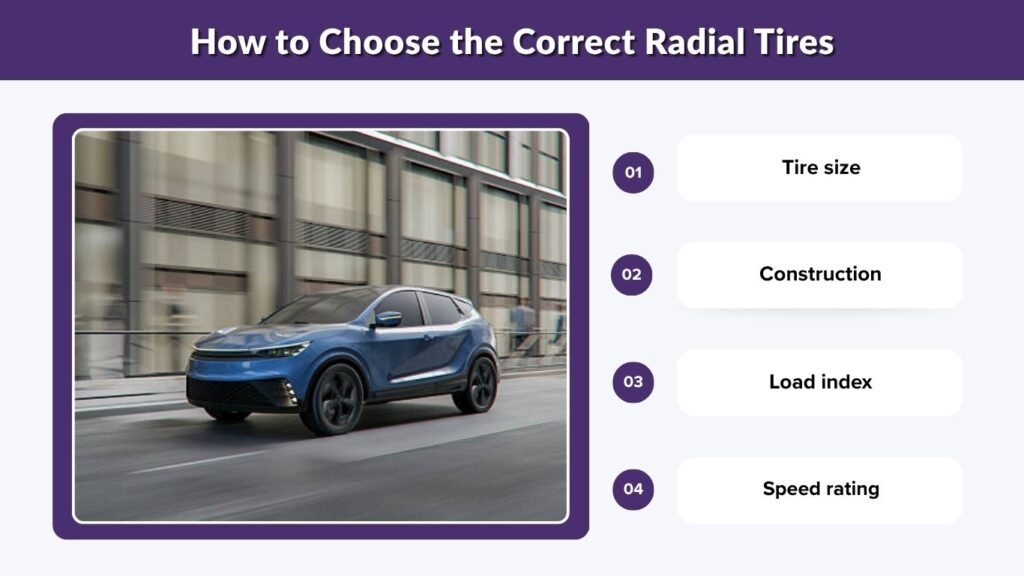
Selecting replacement tires requires more than identifying the R marking. Although most passenger vehicles use radial tires, differences in tire size, load capacity, speed rating, and inflation requirements can significantly affect compatibility. Choosing tires that match manufacturer recommendations helps maintain predictable handling, appropriate weight support, and reliable performance in everyday driving conditions.
Important Things to Check Before Replacing Tires
- Tire size: Match the vehicle manufacturer’s recommended dimensions.
- Construction: Use the specified tire construction type.
- Load index: Confirm the replacement meets or exceeds the required load capacity.
- Speed rating: Select an appropriate rating according to manufacturer requirements.
- Wheel compatibility: Ensure the tire fits the wheel diameter and approved width.
- Inflation pressure: Follow the vehicle’s tire placard and applicable tire specifications.
Can You Replace Bias-Ply Tires With Radial Tires?
Replacing bias-ply tires with radial tires may be possible in some applications, but compatibility must be evaluated.
Differences in tire construction can affect handling, steering response, and vehicle behavior. Older vehicles and specialized equipment may have specific requirements.
A qualified tire professional should confirm suitable sizing, wheel compatibility, inflation requirements, and construction before making the change.
FAQs
Many drivers understand that R stands for Radial but remain confused about its relationship with tire measurements and ratings. Questions frequently involve wheel sizes, sidewall numbers, tire speed ratings, and abbreviations used on specialty tires. The following answers explain these differences and help clarify how to interpret common tire markings when checking existing tires or considering replacements.
1. What Does the R on a Tire Size Mean?
R stands for Radial construction. It describes the arrangement of reinforcing cords inside the tire rather than its dimensions or speed rating.
2. What Does R18 Mean on a Tire?
R18 means the tire has radial construction and is designed for an 18-inch diameter wheel. It does not indicate an overall tire diameter of 18 inches.
3. What Does 70R Mean on a Tire?
In a size such as 265/70R17, 70 represents the tire’s aspect ratio, while R indicates radial construction. Together, they form part of the complete tire-size designation.
4. What Does Speed Rating R Mean on a Tire?
An R speed rating indicates a maximum rated speed of 106 mph (170 km/h) under specified conditions. This differs from R within the tire-size code, which identifies radial construction.
5. Are All Modern Car Tires Radial?
Almost all modern passenger cars use radial tires because they provide an effective combination of comfort, stability, efficiency, and durability. However, bias-ply tires remain available for certain specialized vehicles and equipment.