
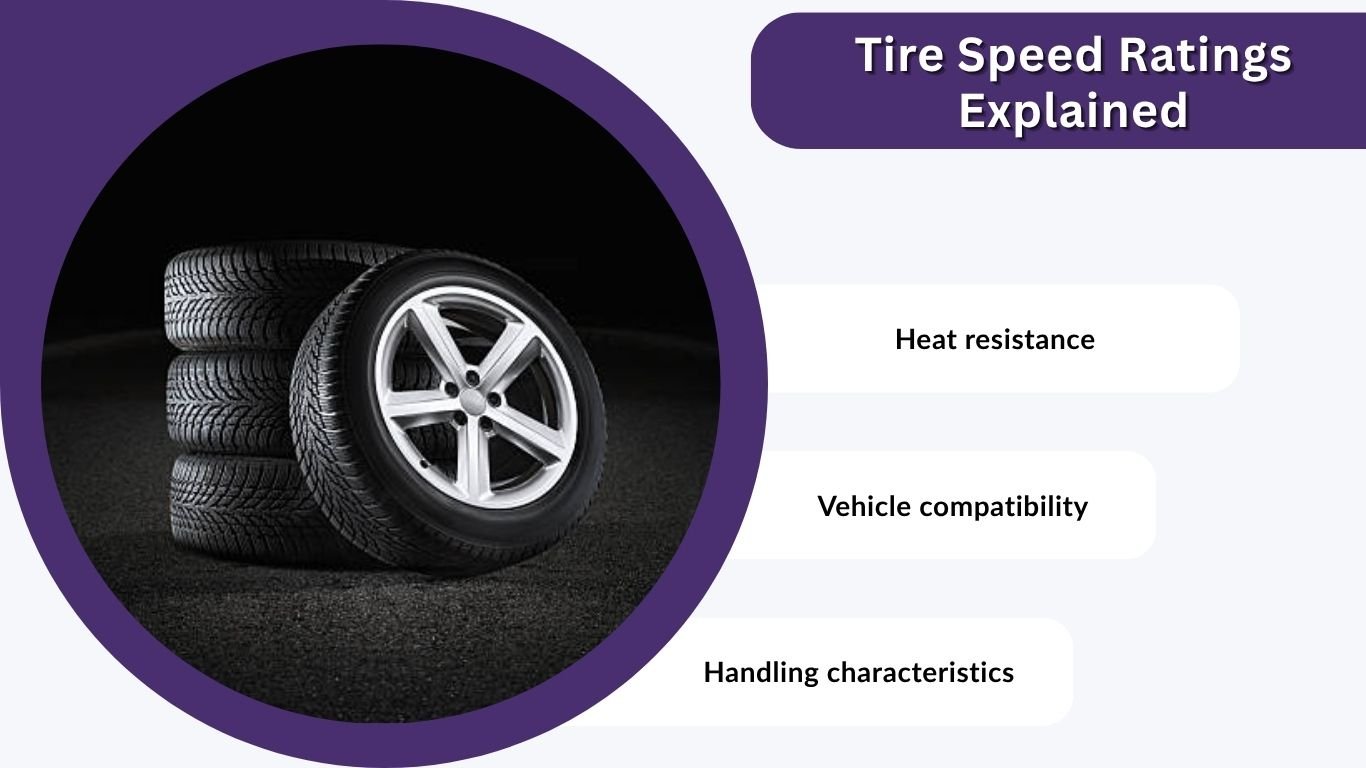
Tire speed ratings explained simply can help you understand what those letters on your tire sidewall mean and why they matter for vehicle safety. Every tire has a speed rating that indicates its maximum tested speed capability under specified conditions. These ratings also relate to tire construction, handling characteristics, and driving performance. Whether you drive a sedan, SUV, sports car, or motorcycle, knowing how tire speed ratings work helps you select suitable replacements and avoid potential safety problems on the road.
What Are Tire Speed Ratings?
A tire speed rating is a standardized letter code indicating the maximum speed a tire is designed to sustain while carrying its rated load under specified operating conditions. Manufacturers establish these ratings through controlled testing. Understanding the rating is important because tires must meet the performance requirements established for your vehicle, even when your everyday driving speed is relatively low.
What Does a Tire Speed Rating Mean?
Speed ratings use letters such as S, T, H, V, W, and Y to identify different speed capabilities.
For example, a tire marked 91H has an H speed rating, corresponding to a maximum rated speed of 130 mph.
However, this does not mean driving at 130 mph is automatically safe. Road conditions, tire pressure, vehicle loading, and tire wear can significantly affect safety.
Why Tire Speed Ratings Matter
Speed ratings help drivers understand several important tire characteristics:
- Heat resistance: The tire’s ability to handle heat generated during high-speed operation.
- Vehicle compatibility: Whether the tire meets the manufacturer’s performance specifications.
- Handling characteristics: The relationship between tire construction and steering response.
- Driving safety: Appropriate tire selection helps reduce the risks associated with using unsuitable tires.
- Replacement decisions: Ratings help compare compatible tires before installation.
A tire’s speed rating is only one part of its performance specification. Proper inflation, tread condition, and load capacity remain essential.
Tire Speed Rating Chart Explained
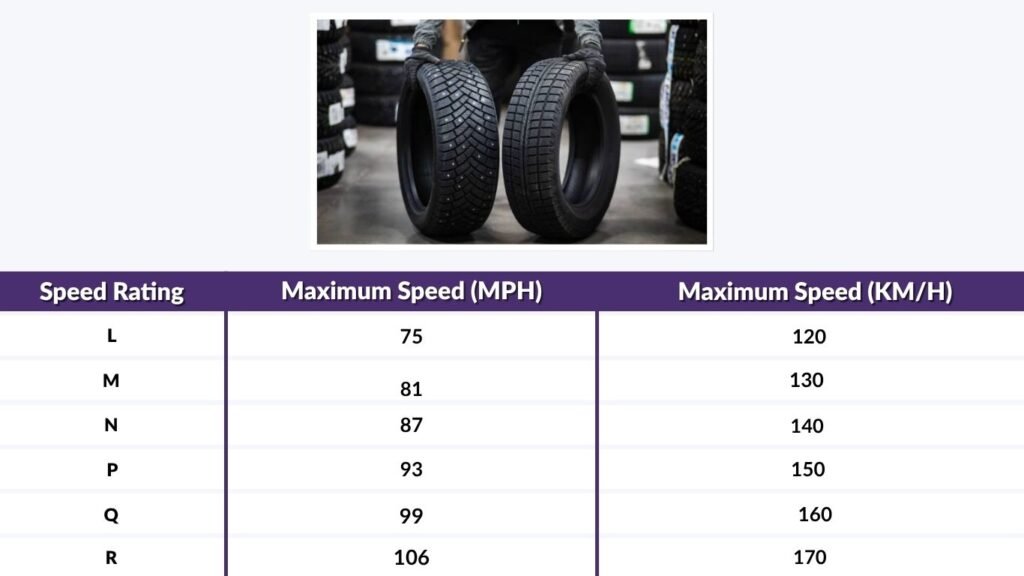
The tire speed rating chart shows the maximum rated speed associated with each letter code. These ratings follow internationally recognized standards and apply to various tire categories, including passenger cars, light trucks, and performance vehicles. Although most everyday vehicles use T, H, or V-rated tires, understanding the complete chart helps drivers interpret tire markings more accurately.
Complete Tire Speed Rating Chart
| Speed Rating | Maximum Speed (MPH) | Maximum Speed (KM/H) |
| L | 75 | 120 |
| M | 81 | 130 |
| N | 87 | 140 |
| P | 93 | 150 |
| Q | 99 | 160 |
| R | 106 | 170 |
| S | 112 | 180 |
| T | 118 | 190 |
| U | 124 | 200 |
| H | 130 | 210 |
| V | 149 | 240 |
| W | 168 | 270 |
| Y | 186 | 300 |
| (Y) | Over 186 | Over 300 |
These values represent standardized speed capabilities, not recommended driving speeds. Actual safe speeds depend on legal limits, driving conditions, and tire condition.
What Do ZR and (Y) Tire Ratings Mean?
The ZR designation identifies tires designed for speeds exceeding 149 mph. Modern ZR tires typically include an additional W, Y, or (Y) service rating to specify their speed capability more precisely.
For example, a tire labeled 225/45ZR17 94W has a W rating of 168 mph. A tire marked (99Y) indicates a capability exceeding 186 mph, subject to the manufacturer’s specifications.
How to Read Tire Speed Ratings on the Sidewall
Tire sidewalls contain several numbers and letters describing their dimensions, construction, load capacity, and speed capability. These markings can initially appear confusing, but their arrangement follows a recognizable format. Learning how to interpret the tire sidewall helps you identify the correct speed rating and avoid selecting replacement tires based solely on size or appearance.
Tire Sidewall Markings Explained
Consider this example:
Example tire marking: 205/55R16 91V
- 205: Tire width in millimeters.
- 55: Sidewall height as a percentage of tire width.
- R: Radial tire construction.
- 16: Wheel diameter in inches.
- 91: Load index.
- V: Speed rating, corresponding to 149 mph.
The speed rating generally appears immediately after the load index in the tire’s service description.
Tire Load Index and Speed Rating Explained
The load index identifies how much weight a tire can support under specified conditions, while the speed rating indicates its maximum rated speed.
For example, a 91V tire has a load index of 91, corresponding to 1,356 pounds (615 kilograms) per tire, and a V speed rating of 149 mph.
Both ratings matter when choosing replacement tires.
How Tire Speed Ratings Affect Driving Performance
Tire speed ratings are associated with performance characteristics beyond maximum speed. Tires designed for higher speeds often use construction features intended to manage heat and maintain stability. However, a higher rating does not automatically make a tire better in every situation. Tire compound, tread design, sidewall construction, and intended use also influence comfort, traction, and steering response.
Tire Speed Ratings and Ride Quality
Performance-oriented tires may have stiffer construction, which can improve steering precision but sometimes produce a firmer ride.
Touring tires often prioritize comfort, road noise, and everyday handling. However, two tires with the same speed rating can feel noticeably different.
Therefore, speed rating alone cannot determine whether a tire will deliver a smoother or more comfortable driving experience.
H vs. V vs. W Tire Speed Ratings
H, V, and W are common ratings across touring and performance tire categories.
An H-rated tire supports speeds up to 130 mph and is frequently found on sedans and crossovers. V-rated tires support up to 149 mph and are common on performance-oriented vehicles.
W-rated tires support up to 168 mph and generally serve higher-performance applications.
The correct choice depends on the vehicle manufacturer’s specifications rather than personal preference alone.
How to Choose the Right Tire Speed Rating
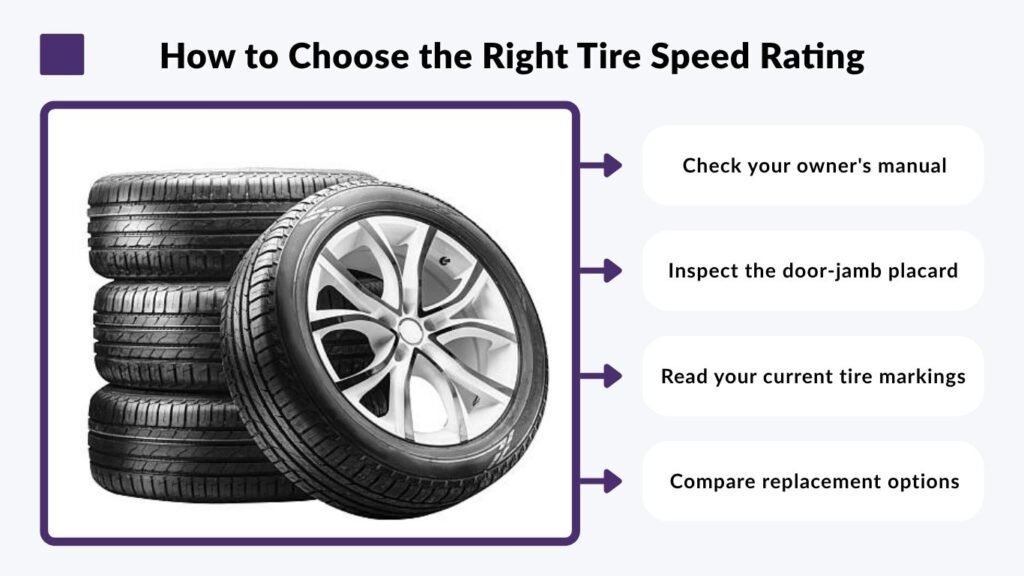
Selecting the correct tire speed rating requires more than checking the vehicle’s maximum speed. Automakers specify tires based on handling, stability, load requirements, and vehicle design. Installing a tire with an unsuitable rating may change driving characteristics. Always verify the original equipment specifications before purchasing tires, especially when switching between touring, performance, all-season, and winter models.
Steps to Select the Correct Speed Rating
- Check your owner’s manual: Identify the tire specifications recommended by the manufacturer.
- Inspect the door-jamb placard: Find the original tire size and any listed service specifications.
- Read your current tire markings: Identify the load index and speed-rating letter.
- Compare replacement options: Choose tires that meet the manufacturer’s required specifications.
- Consider driving conditions: Evaluate climate, road surfaces, and tire category before making your selection.
Can You Use a Higher or Lower Speed Rating?
A higher speed-rated tire may be suitable when its dimensions, load capacity, and other specifications are compatible with your vehicle.
However, choosing a lower rating than the manufacturer recommends is generally discouraged.
Some winter tire applications permit a lower speed rating under specific conditions. Drivers must then respect the lower tire speed limit and applicable manufacturer instructions.
Motorcycle Tire Speed Ratings Explained
Motorcycle tire speed ratings follow similar principles to passenger vehicle ratings, but motorcycle tires have different construction and handling requirements. A motorcycle’s tires must support its intended performance while maintaining appropriate load capacity and stability. Because the front and rear tires perform different functions, selecting ratings based on the motorcycle manufacturer’s specifications is particularly important.
How Motorcycle Tire Speed Codes Work
A motorcycle tire may display a marking such as 180/55ZR17 M/C (73W).
In this example, 73 is the load index, while (W) indicates a speed capability exceeding 168 mph.
Motorcycle ratings can include special parenthesized symbols. They should not be confused with passenger-car (Y) ratings.
Always check the motorcycle manufacturer’s approved tire specifications rather than choosing tires solely by their maximum speed capability.
Common Tire Speed Rating Mistakes to Avoid
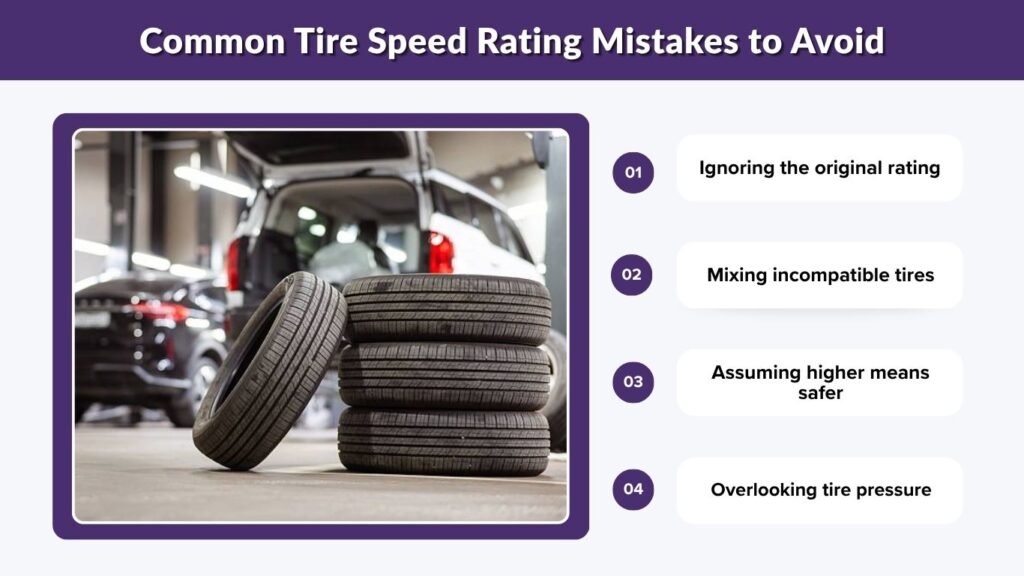
Drivers sometimes overlook speed ratings when replacing worn or damaged tires. Although the markings are relatively small, they affect tire compatibility and vehicle performance. Understanding common mistakes can help prevent inappropriate tire selection. Speed ratings should always be considered alongside tire size, load capacity, pressure, overall condition, and the manufacturer’s requirements.
Mistakes Drivers Should Avoid
- Ignoring the original rating: Selecting tires without checking the manufacturer’s recommendations.
- Mixing incompatible tires: Combining different performance categories or speed ratings without manufacturer approval.
- Assuming higher means safer: Believing a higher rating guarantees better braking or wet-road traction.
- Overlooking tire pressure: Driving with underinflated tires increases heat buildup.
- Using damaged tires: A tire’s original speed capability cannot be assumed after structural damage.
Proper maintenance is just as important as choosing an appropriate speed rating.
FAQs
Tire speed ratings often raise questions about everyday driving, replacement compatibility, and safety. Many drivers wonder whether a higher rating improves performance or whether they can change ratings when buying new tires. The following answers explain common concerns and provide practical guidance for understanding tire speed-rating codes without confusing them with legal speed limits or tire load requirements.
1. What is the best tire speed rating for everyday driving?
There is no single best rating for every vehicle. T, H, and V are common passenger-car ratings. The appropriate choice is the one that meets the vehicle manufacturer’s specifications.
2. Is an H or V tire speed rating better?
A V-rated tire has a higher maximum speed capability than an H-rated tire. However, this does not automatically mean it offers better comfort, braking, or traction.
3. Can I replace H-rated tires with V-rated tires?
Generally, yes, provided the replacement tires meet the vehicle’s size, load, and other manufacturer requirements.
4. Does a higher tire speed rating mean better quality?
Not necessarily. Tire quality depends on construction, materials, traction, durability, and other performance characteristics. Speed rating primarily identifies a standardized speed capability.
5. What happens if you exceed a tire’s speed rating?
Exceeding the rated speed increases the risk of excessive heat buildup and tire failure. The exact outcome depends on tire condition, pressure, load, and driving circumstances.