
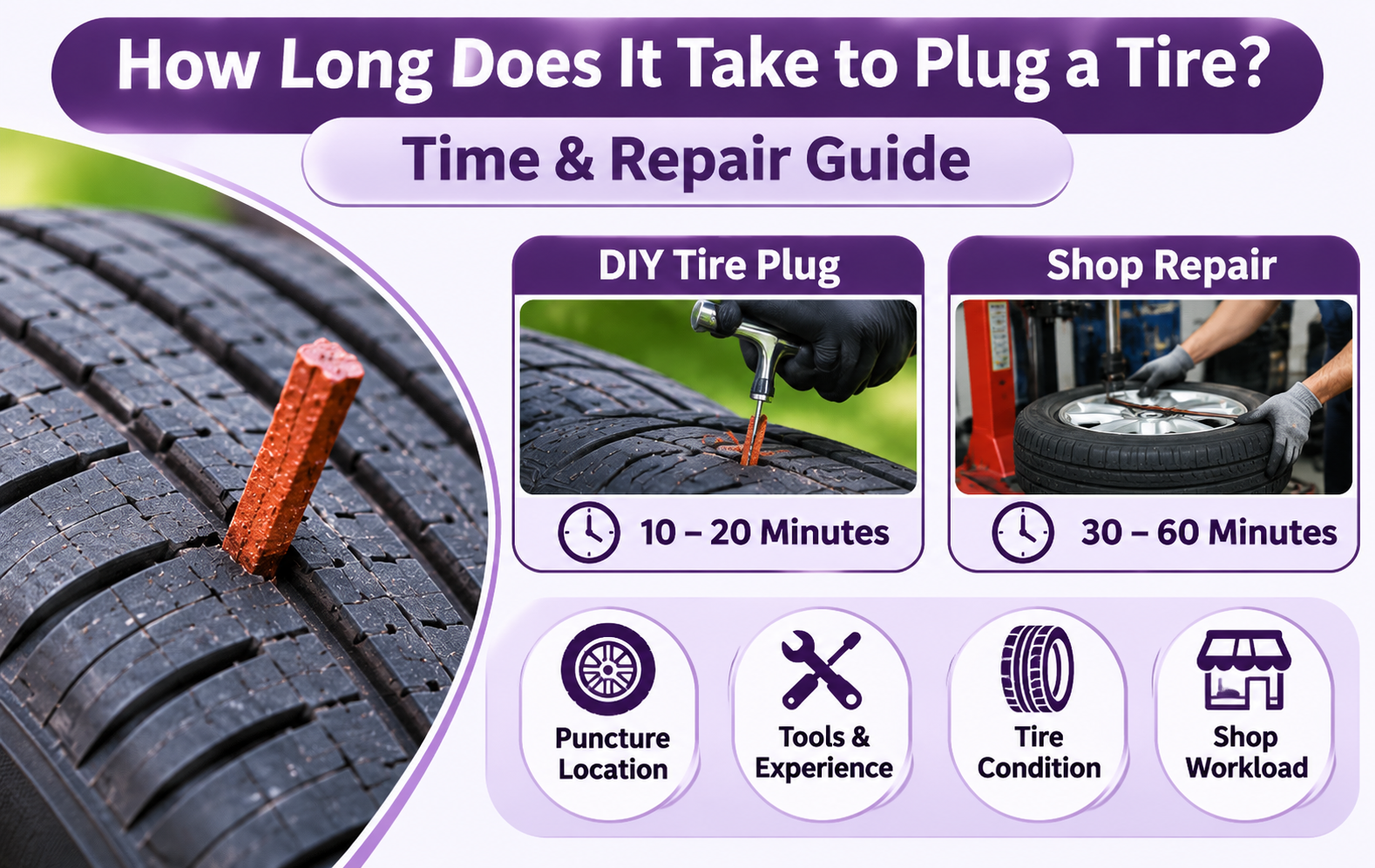
A tire puncture can interrupt your day, especially when you’re running late or traveling far from home. If you have a repair kit, you might wonder, how long does it take to plug a tire? A simple emergency tire plug installation typically takes around 10 to 20 minutes once the puncture is accessible. However, a professional tire repair usually takes longer because the tire must be removed and inspected internally. The actual time depends on the puncture location, tire condition, tools, and repair method. This guide explains typical repair times, each step involved, and important safety considerations.
How Long Does It Usually Take to Plug a Tire?
The time needed to plug a tire depends primarily on whether you’re installing an emergency string plug or having a professional repair completed. A simple external plug can be installed relatively quickly, but it is not considered a permanent repair. A qualified technician needs additional time to examine the tire and perform an approved internal repair.
Average Tire Plug Repair Time
Here are some approximate repair times for common situations:
| Tire Repair Method | Estimated Time |
|---|---|
| Emergency tire plug installation | 10–20 minutes |
| First-time DIY emergency plug | 20–30 minutes |
| Finding a difficult puncture | Additional 5–15 minutes |
| Professional plug-patch repair | 30–60 minutes |
| Tire removal and replacement | 30–60 minutes |
These are general planning estimates, not guaranteed service times. Shop waiting periods, equipment availability, and tire condition can increase the total.
Why Professional Tire Repair Takes Longer
Professional tire repairs involve more than inserting a rubber strip into a puncture.
A technician removes the tire from the wheel, examines the inner liner, checks for structural damage, and determines whether the puncture is repairable.
For a suitable puncture, the technician fills the injury channel and seals the inner liner using an approved plug-patch repair.
The tire must then be remounted, inflated, checked, and balanced as needed.
These additional procedures explain why a proper repair takes longer than an emergency plug installation.
What Factors Affect How Long It Takes to Plug a Tire?
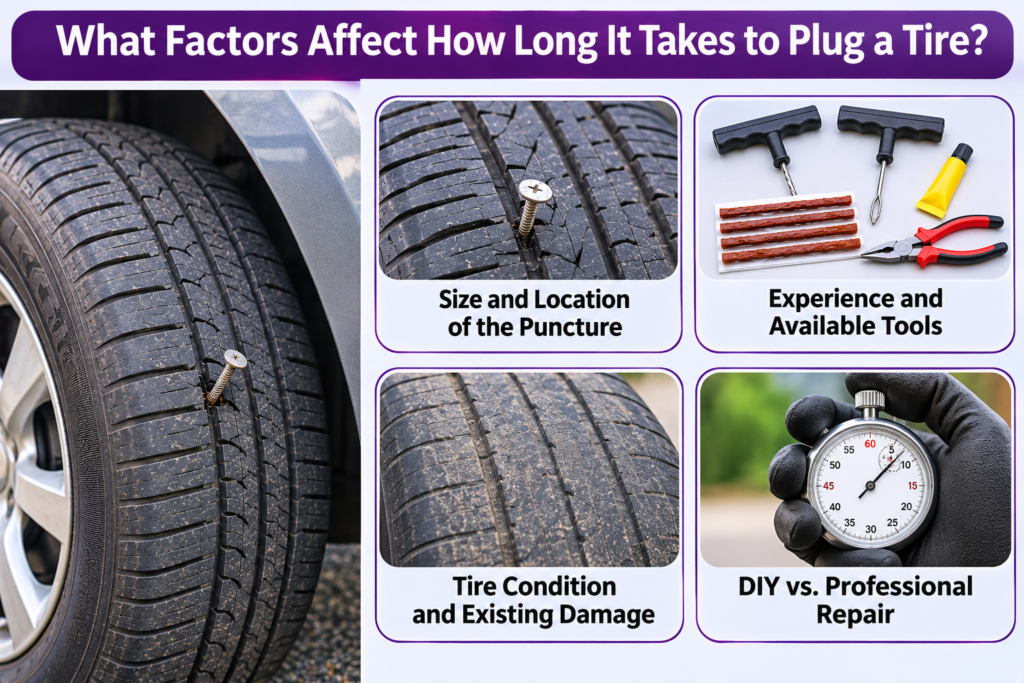
Several factors influence tire repair time. Even a small puncture can require additional work if its location is difficult to access or the air leak is hard to identify. Understanding these factors helps you estimate how long the process might take and whether the tire needs professional attention instead of a quick repair.
Size and Location of the Puncture
Small punctures in the central tread area are generally easier to locate and assess.
A nail or screw embedded in the tread may be visible immediately. However, damage near the tire shoulder or sidewall is not suitable for a standard puncture repair.
For passenger tires, industry guidance generally limits repairs to punctures no larger than 1/4 inch (6 mm) within the designated tread repair area.
Experience and Available Tools
Someone familiar with tire repair tools may complete a temporary plug installation faster than a beginner.
The repair process also depends on having the appropriate equipment.
Useful tools include:
- Tire plug insertion tool
- Reamer tool
- Rubber plug strips
- Needle-nose pliers
- Portable air compressor
- Tire pressure gauge
- Soapy water for leak detection
Missing equipment can significantly delay the process, particularly when the tire needs reinflation.
Tire Condition and Existing Damage
A tire that has been driven while severely underinflated may have hidden internal damage.
That damage can make the tire unsafe to repair even when the original puncture appears small.
Previous repairs, excessive tread wear, and visible bulges can also affect repairability.
When these problems exist, replacement may be necessary rather than plugging the tire.
How Long Does It Take to Plug a Tire Yourself?
A DIY emergency tire plug installation commonly takes about 10 to 20 minutes for someone familiar with the tools. Beginners may need longer, especially when locating the puncture or operating the insertion tool for the first time. Remember that an external string plug is an emergency measure and does not replace a professional inspection and repair.
Step 1: Locate the Puncture (2–5 Minutes)
Inspect the tire tread for nails, screws, or other foreign objects.
If you cannot immediately find the leak, spray soapy water over the tread and look for bubbles.
Mark the puncture location once identified.
Do not attempt an external plug if the damage is outside the central tread area or the tire shows signs of structural damage.
Step 2: Remove the Object (1–2 Minutes)
If the puncture is suitable for temporary emergency plugging, use pliers to remove the embedded object.
Pull carefully to avoid enlarging the puncture.
Observe the angle at which the object entered the tire, as this helps identify the puncture channel.
If the tire has lost most of its air, professional assistance is safer than attempting to drive on it.
Step 3: Prepare the Hole (2–4 Minutes)
Insert the reaming tool into the puncture following the manufacturer’s instructions.
The tool prepares the channel for the rubber plug.
Use controlled movements without applying excessive force or unnecessarily enlarging the hole.
A puncture that cannot be prepared normally should be assessed by a tire professional.
Step 4: Insert the Rubber Plug (2–4 Minutes)
Thread a rubber plug through the insertion tool.
Apply rubber cement only if your kit instructions require it.
Carefully insert the plug to the recommended depth, then withdraw the tool while leaving the plug in place.
Follow the kit’s instructions for trimming any excess rubber.
Step 5: Inflate and Check for Leaks (3–5 Minutes)
Inflate the tire to the vehicle manufacturer’s recommended pressure.
Check the pressure using a tire gauge, then apply soapy water to the temporary repair area.
Watch for bubbles that indicate continued air leakage.
Even if the tire holds pressure, arrange a professional internal inspection promptly. Do not treat the external plug as a permanent repair.
How Long Does It Take to Plug a Tire at a Shop?
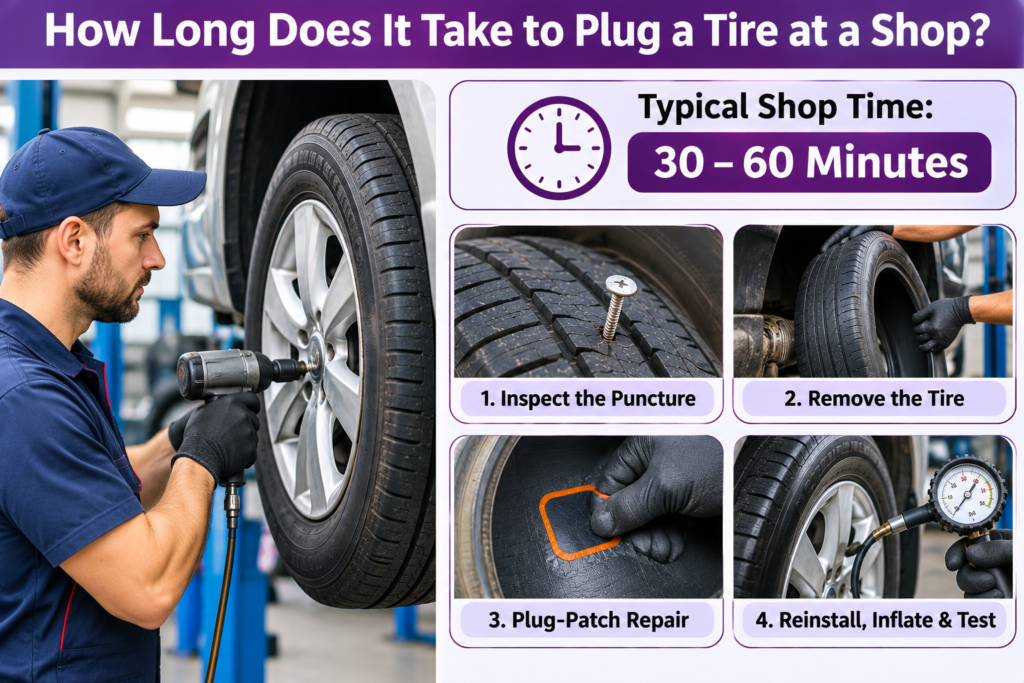
A professional tire repair typically requires around 30 to 60 minutes of actual service time. However, the total appointment may take longer depending on the shop’s workload. Technicians follow additional procedures that are necessary for a safe repair. The tire must also meet specific repairability requirements before the shop can complete the work.
Professional Tire Inspection
The technician first examines the puncture location and the tire’s overall condition.
The tire is then removed from the wheel so its inner surface can be inspected.
This inspection helps identify damage caused by driving with low pressure, exposed cords, previous repairs, or other problems.
If the tire is unsuitable for repair, the technician should recommend replacement.
Plug-Patch Repair and Final Testing
A proper professional repair fills the puncture channel and seals the inner liner.
A combination plug-patch unit can accomplish both functions when installed correctly.
After repairing the tire, the technician remounts it, inflates it to the appropriate pressure, and checks for leaks.
Wheel balancing may also be required.
Although this process takes additional time, it addresses problems that an external string plug cannot.
How Long Does a Tire Plug Take to Dry or Set?
Another common question is whether a tire plug needs time to dry before the tire can be inflated. The answer depends on the type of repair kit. Some emergency string plugs use sticky, self-vulcanizing materials, while others require rubber cement. There is no universal drying or curing time that applies to every tire plug product.
Does a Tire Plug Need Rubber Cement?
Not every tire plug kit requires rubber cement.
Some plugs are designed for installation without additional adhesive. Other products include cement or bonding chemicals as part of their application procedure.
Always follow the instructions supplied with the specific repair kit.
Do not assume that adding more adhesive makes the repair stronger or safer.
Can You Drive Immediately After Plugging?
Some emergency plug kits are designed to allow inflation and leak testing immediately after installation.
However, this does not mean the tire is permanently repaired or suitable for unrestricted driving.
If a temporary plug appears to hold pressure, follow the kit and tire manufacturer’s limitations and seek professional inspection as soon as possible.
Avoid high speeds, heavy loads, and unnecessary travel.
If air leakage continues, do not drive on the tire.
Tire Plug vs. Tire Patch: Which Takes Longer?
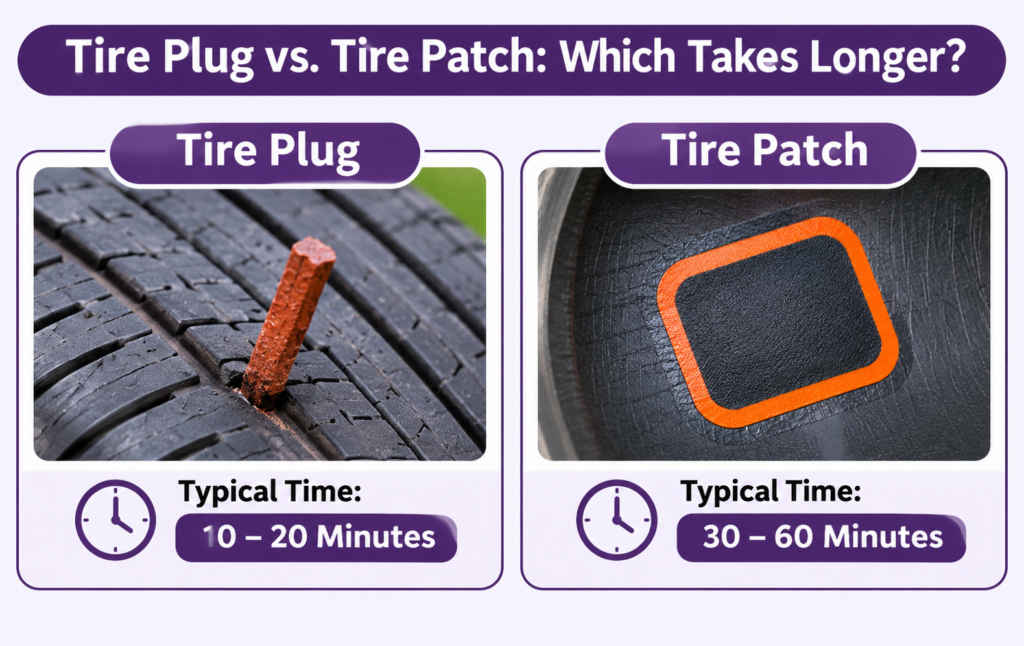
Tire plugs and patches are commonly compared because both relate to puncture repair. However, they perform different functions. An external plug fills a puncture channel, while an internal patch seals the inner liner. A proper permanent passenger-tire puncture repair normally requires both functions, rather than relying on either method alone.
Tire Plug Installation Time
An emergency string plug generally takes less time because it can often be installed without removing the tire from the wheel.
The main tasks involve finding the puncture, preparing the channel, inserting the plug, and checking for leaks.
This faster process is useful in certain emergencies, but external plugs are not approved as permanent repairs under established industry guidance.
Professional Plug-Patch Repair Time
A professional plug-patch repair usually takes longer because the technician must remove the tire and inspect it internally.
The puncture channel must be prepared and filled, and the inner liner must be properly sealed.
The tire is then reinstalled and tested.
Although the process may take 30 to 60 minutes, it provides the appropriate repair method when the puncture is eligible for repair.
How Long Does a Tire Plug Last?
An external tire plug may remain airtight for some time, but its duration is unpredictable. Some emergency plugs appear to hold air for months, while others can begin leaking much sooner. The fact that a plug retains pressure does not establish that the tire is structurally sound or safe for long-term driving.
Is a Tire Plug a Permanent Fix?
No. An external string plug alone is not considered an acceptable permanent passenger-tire repair.
It does not adequately seal the inner liner or allow an inspection of potential internal damage.
For a permanent repair, the tire must be professionally inspected and repaired using an approved method that fills the puncture and seals the inner liner.
When Should You Replace the Tire?
Not every punctured tire can be repaired safely.
Replacement may be necessary when:
- The puncture is in the sidewall or shoulder.
- The hole exceeds 1/4 inch (6 mm).
- The tire has visible bulges or exposed cords.
- The tire has internal damage from underinflated driving.
- The tread is excessively worn.
- Existing repairs overlap or the tire has an improper prior repair.
A professional technician should determine whether the tire is repairable.
FAQs
1. How Long Does It Take to Plug a Tire With a Nail in It?
Installing a temporary emergency plug in a small nail puncture may take approximately 10 to 20 minutes. The total depends on puncture accessibility, available tools, and experience. A professional permanent repair takes longer because internal inspection and plug-patch installation are required.
2. Can You Plug a Tire in 5 Minutes?
An experienced person might physically insert an emergency plug within five minutes when the puncture is already located. However, that estimate excludes preparation, inflation, and leak testing. It also does not account for the professional inspection and repair required for long-term use.
3. How Long Does It Take to Plug a Tire at a Tire Shop?
Professional tire repair commonly takes 30 to 60 minutes, although the shop’s schedule can increase your wait. The technician removes the tire, checks for internal damage, completes an approved plug-patch repair when appropriate, and reinstalls and tests the tire.
4. How Long Can You Drive After Plugging a Tire?
There is no universally safe driving distance after installing an external tire plug. Its purpose is temporary emergency assistance, not normal long-term service. Follow the manufacturer’s restrictions and arrange professional inspection promptly. Never continue driving if the tire loses pressure.
5. Is It Faster to Plug a Tire or Replace It?
Installing an emergency string plug is usually faster than replacing a tire. However, it is not a permanent repair. A professional repair and tire replacement may take similar amounts of shop time, depending on equipment, tire condition, and service availability.