
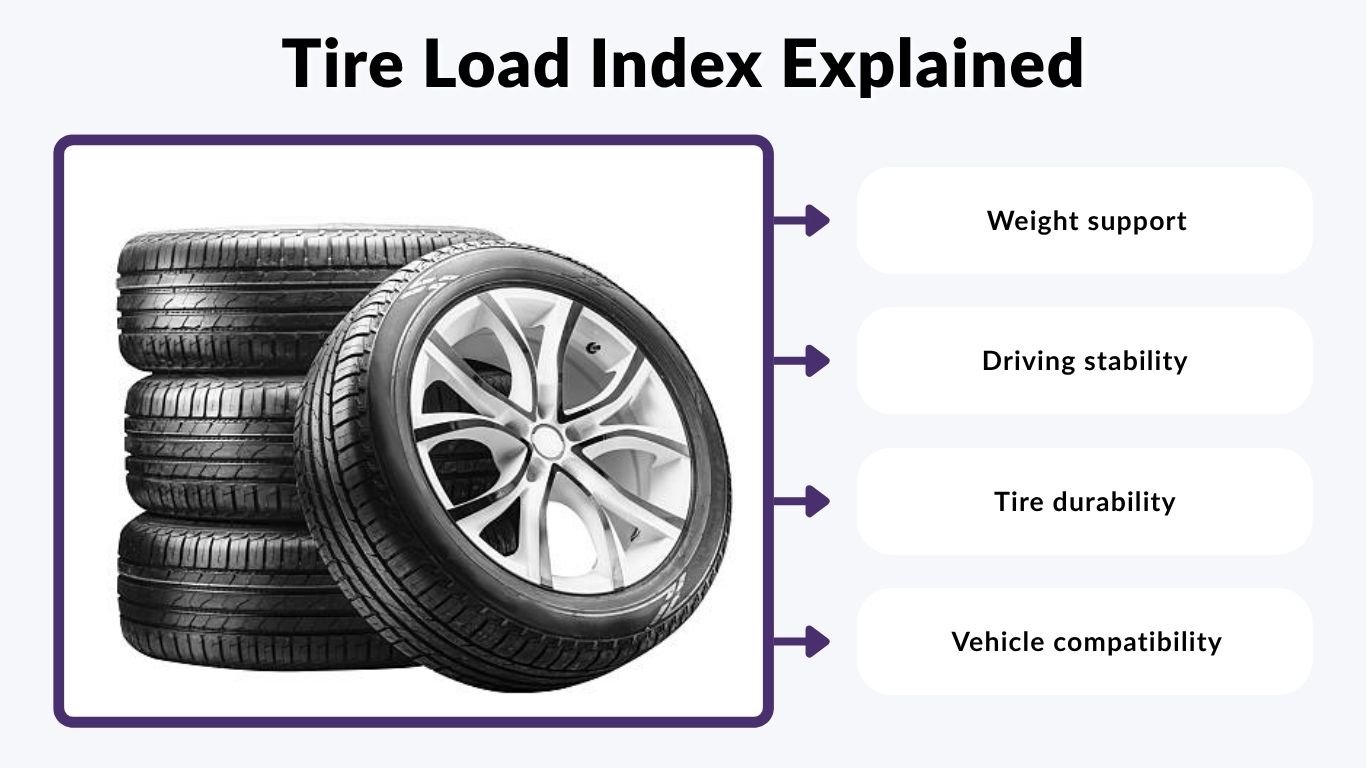
Understanding tire load index ratings is essential when choosing safe and reliable tires for your vehicle. The tire load index is a numerical code showing how much weight an individual tire can support under specified conditions. Whether you drive a sedan, SUV, pickup truck, or motorcycle, selecting the correct load rating helps maintain vehicle stability, handling, and tire performance. This guide explains tire load index numbers, provides a useful load capacity chart, and shows how to identify the correct rating when replacing your vehicle’s tires.
What Is a Tire Load Index?
A tire load index is a standardized numerical rating that represents the maximum weight a tire can carry when properly inflated under specified operating conditions. The number normally appears near the end of the tire’s size marking, immediately before the speed-rating letter. Higher numbers indicate greater load-carrying capacity, making this rating an important consideration when purchasing replacement tires.
What Does the Tire Load Index Mean?
For example, a tire with a load index of 91 can carry up to 1,356 pounds (615 kilograms) under the appropriate conditions.
A tire with a load index of 95 can support 1,521 pounds (690 kilograms).
These numbers refer to individual tires, not the entire vehicle. They also do not indicate how much additional cargo a vehicle can safely carry.
Why Tire Load Index Ratings Matter
The correct load index contributes to several aspects of vehicle safety:
- Weight support: Helps tires carry the vehicle’s intended load.
- Driving stability: Supports predictable performance during normal driving.
- Tire durability: Reduces the risk associated with exceeding load limits.
- Vehicle compatibility: Ensures replacement tires meet manufacturer requirements.
- Passenger safety: Helps maintain adequate tire capacity when carrying passengers and luggage.
Using tires with insufficient load capacity can lead to excessive heat buildup, accelerated wear, and potential tire failure.
Tire Load Index Chart Explained
A tire load index chart converts numerical ratings into maximum weight capacities in pounds and kilograms. This information helps drivers compare tire specifications and understand the difference between common load ratings. Although passenger vehicles frequently use ratings between 75 and 105, heavier vehicles may require higher values. The chart below shows several common ratings and their corresponding weight limits.
Tire Load Index Chart: Pounds and Kilograms
| Load Index | Maximum Load (lbs) | Maximum Load (kg) |
| 75 | 853 | 387 |
| 80 | 992 | 450 |
| 85 | 1,135 | 515 |
| 87 | 1,201 | 545 |
| 89 | 1,279 | 580 |
| 90 | 1,323 | 600 |
| 91 | 1,356 | 615 |
| 92 | 1,389 | 630 |
| 93 | 1,433 | 650 |
| 94 | 1,477 | 670 |
| 95 | 1,521 | 690 |
| 96 | 1,565 | 710 |
| 97 | 1,609 | 730 |
| 98 | 1,653 | 750 |
| 99 | 1,709 | 775 |
| 100 | 1,764 | 800 |
| 102 | 1,874 | 850 |
| 104 | 1,984 | 900 |
| 105 | 2,039 | 925 |
| 110 | 2,337 | 1,060 |
These are standardized per-tire capacities at the applicable rated inflation conditions.
How to Calculate Tire Load Capacity
Consider four tires with a load index of 91.
Each tire supports a maximum rated load of 1,356 pounds.
Multiplying 1,356 by four gives a combined theoretical tire capacity of 5,424 pounds.
However, this does not establish the vehicle’s maximum permitted weight. The vehicle’s gross vehicle weight rating (GVWR), axle weight ratings, tire pressure, and actual weight distribution must also be considered.
How to Read Tire Load Index and Sidewall Markings
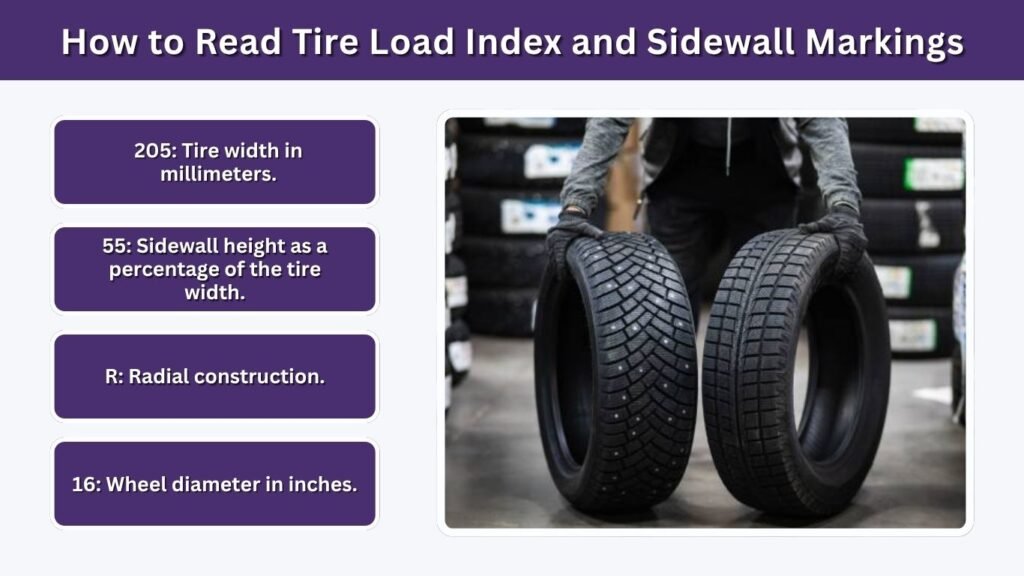
Tire sidewall markings provide essential information about tire dimensions, construction, weight capacity, and maximum speed capability. Understanding these codes helps prevent mistakes when selecting replacement tires. Most modern passenger tires follow a similar marking format, making it relatively easy to identify the load index once you understand where the number appears and what it represents.
Tire Sidewall Markings Explained
Consider the marking 205/55R16 91V.
The highlighted 91 identifies the tire load index.
- 205: Tire width in millimeters.
- 55: Sidewall height as a percentage of the tire width.
- R: Radial construction.
- 16: Wheel diameter in inches.
- 91: Tire load index, equivalent to 1,356 pounds.
- V: Speed rating, equivalent to 149 mph.
Where to Find Your Vehicle’s Recommended Load Index
Check your owner’s manual and tire specifications. The driver’s door-jamb tire placard also provides original tire size, recommended inflation pressure, and vehicle loading information.
If you are unsure which load rating is required, consult a qualified tire professional.
Tire Load Index and Speed Rating Explained
The tire load index and speed rating appear together in the service description but represent different performance limitations. The load index identifies weight-carrying capability, while the speed rating indicates the maximum rated speed under specified conditions. Both are important for replacement tire compatibility. Understanding their differences helps drivers avoid confusing weight capacity with maximum speed or overall tire quality.
Difference Between Load Index and Speed Rating
| Feature | Load Index | Speed Rating |
| Purpose | Weight capacity | Speed capability |
| Code | Numerical | Alphabetical |
| Example | 91 | V |
| Meaning | 1,356 lbs per tire | 149 mph |
| Primary concern | Safe weight support | High-speed capability |
A tire marked 91V combines both ratings. Neither specification should be ignored when selecting replacement tires.
Can a Higher Load Index Improve Performance?
A higher load index means the tire can carry more weight under its specified conditions.
However, it does not automatically improve braking, steering, traction, or ride quality.
Those characteristics also depend on tread design, tire construction, rubber compounds, and vehicle compatibility.
How to Choose the Correct Tire Load Index
Choosing the correct tire load index requires checking the manufacturer’s specifications rather than estimating how much your vehicle weighs. Different vehicles place different loads on their tires, especially when carrying passengers, cargo, or towing equipment. The original tire rating is an important starting point, but appropriate tire type, inflation pressure, and axle load limits are equally essential.
Steps to Choose the Right Load Index
- Check the owner’s manual: Find the manufacturer’s recommended tire specifications.
- Inspect the tire placard: Confirm the original tire size and recommended inflation pressures.
- Identify the current load index: Read the number before the speed-rating letter.
- Compare replacement tires: Select a compatible tire with adequate load capacity.
- Verify vehicle requirements: Consider axle ratings, load range, and any manufacturer-specific instructions.
Can You Use a Higher or Lower Tire Load Index?
A higher load index is generally acceptable when the replacement tire meets the vehicle’s other requirements.
A lower load index should not be substituted for the manufacturer’s specified rating without an explicitly approved alternative.
Using an insufficient load rating may compromise safe operation, particularly when the vehicle is fully loaded.
Standard Load vs. Extra Load vs. Light Truck Tires
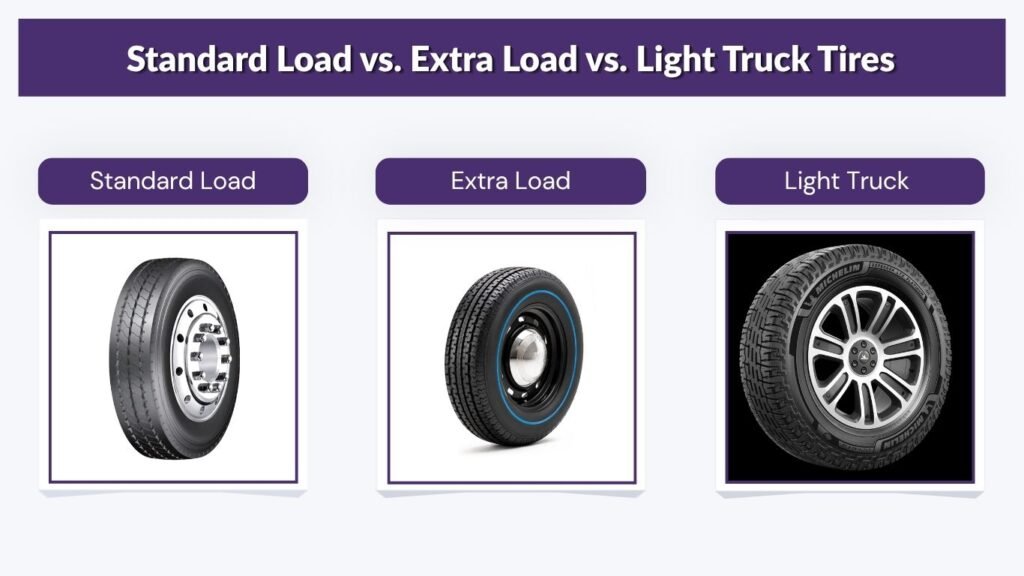
Tire load index numbers are also associated with different tire categories and load ranges. Standard Load, Extra Load, and Light Truck tires are designed for different applications and inflation requirements. Understanding these classifications is useful because two tires of similar dimensions can have different maximum capacities, construction characteristics, and recommended operating pressures.
Standard Load (SL) and Extra Load (XL)
Standard Load tires are designed for typical passenger-vehicle applications.
Extra Load tires, often marked XL, are designed to support additional load at higher specified inflation pressures.
For example, a 205/55R16 91V standard-load tire carries 615 kilograms, while a 205/55R16 94V XL tire carries 670 kilograms at its applicable rated pressure.
Light Truck (LT) Tire Load Index
Light Truck tires may use load ranges such as C, D, or E rather than passenger-tire SL and XL classifications.
Some LT tires show two load indexes, such as 104/101. The first represents capacity in a single-tire installation, while the second applies to dual-wheel installations.
LT tire selection requires checking load-and-inflation specifications carefully.
Motorcycle Tire Load Index Explained
Motorcycle tires also use numerical load indexes, but their requirements differ from passenger-car tires. The correct front and rear tire ratings depend on the motorcycle’s design, weight distribution, and intended performance. Riders must consider the motorcycle itself, passengers, luggage, and accessories when evaluating tire suitability. The manufacturer’s approved specifications should always determine replacement tire selection.
How to Read Motorcycle Tire Load Ratings
Consider the marking 180/55ZR17 M/C (73W).
The number 73 indicates a maximum load of 805 pounds (365 kilograms) per tire.
The (W) designation represents a speed capability exceeding 168 mph under the manufacturer’s specified conditions.
Motorcycle tires should meet the approved load and speed specifications for their respective wheel positions.
Common Tire Load Index Mistakes to Avoid
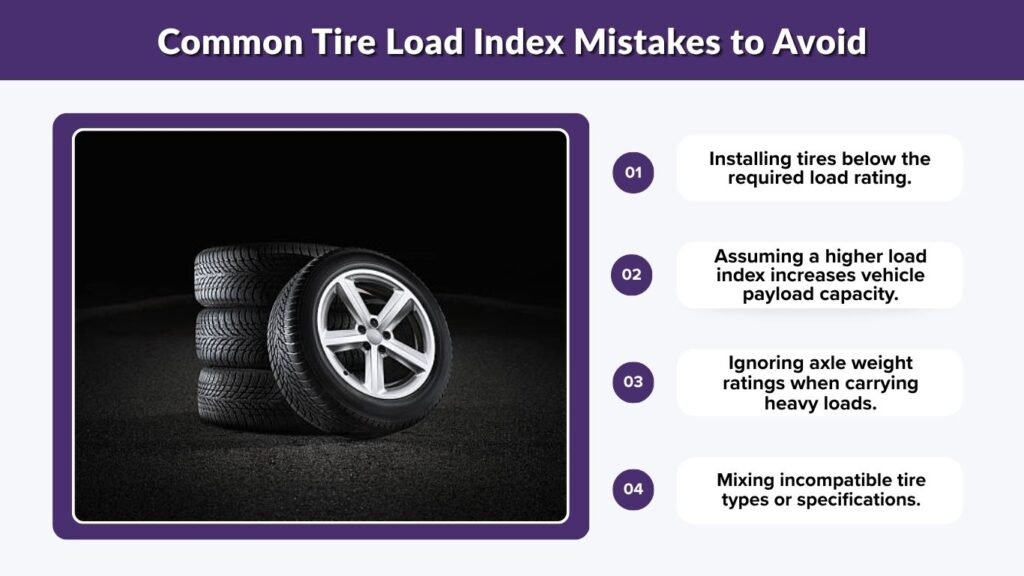
Many tire-related problems begin with incorrect replacement specifications or improper inflation pressure. Choosing a tire solely by its dimensions can overlook important load requirements. Similarly, drivers sometimes assume a higher load index permits carrying additional cargo beyond the vehicle’s stated limits. Recognizing these mistakes helps ensure that tire selection and maintenance remain consistent with manufacturer recommendations.
Common Mistakes
- Installing tires below the required load rating.
- Assuming a higher load index increases vehicle payload capacity.
- Confusing maximum sidewall pressure with recommended inflation pressure.
- Ignoring axle weight ratings when carrying heavy loads.
- Mixing incompatible tire types or specifications.
Always follow the vehicle manufacturer’s cold inflation recommendations and avoid exceeding vehicle loading limits.
FAQs
Understanding tire load index ratings becomes easier when examining common replacement and maintenance questions. Drivers often want to know whether higher ratings are better, how index numbers relate to actual weight, and whether different ratings can be installed. These answers address the most common concerns and help explain how tire load capacity relates to vehicle safety.
1. What does a tire load index of 91 mean?
A tire load index of 91 means that one tire can support a maximum rated load of 1,356 pounds (615 kilograms) under specified conditions.
2. Is a higher tire load index better?
A higher load index provides greater rated weight capacity, but it does not necessarily improve tire comfort, traction, handling, or durability.
3. Can I replace 91 load index tires with 94?
Generally, yes, if the new tires meet the vehicle manufacturer’s size, speed-rating, inflation, and other compatibility requirements.
4. What happens if the tire load index is too low?
An insufficient load index can increase the risk of overloading, excessive heat buildup, tire damage, and potential failure.
5. Does tire pressure affect load capacity?
Yes. A tire’s weight-carrying capability depends partly on inflation pressure. Drivers should follow the vehicle manufacturer’s recommended pressure and applicable tire load-and-inflation specifications.