
Front-wheel-drive tire rotation usually follows the forward-cross pattern: the front tires move straight back, while the rear tires cross to the opposite sides at the front. This arrangement distributes the heavier wear experienced by the front tires, which handle acceleration, steering, braking, and much of the vehicle’s cornering load. However, directional tires, staggered wheel sizes, and some manufacturer-specific setups require a different pattern.
Why FWD Tires Need Regular Rotation
In a front-wheel-drive car, the front tires perform more work than the rear tires. They transfer engine power to the road, steer the vehicle, and carry much of the braking load. As a result, the front tread commonly wears faster, especially around the shoulders.
Without regular rotation, the front tires may need replacement long before the rear pair. Rotation moves each tire through different positions, helping the entire set develop more uniform tread wear.
Benefits of Rotating FWD Tires
Regular tire rotation can help:
- Distribute tread wear more evenly
- Extend the usable life of all four tires
- Maintain balanced steering and handling
- Reduce noise caused by irregular wear
- Reveal pressure, alignment, or suspension problems
- Support applicable treadwear warranty requirements
Rotation cannot repair existing tire damage or correct severe wear caused by poor alignment, improper inflation, wheel imbalance, or worn suspension parts.
Best Front-Wheel-Drive Tire Rotation Pattern
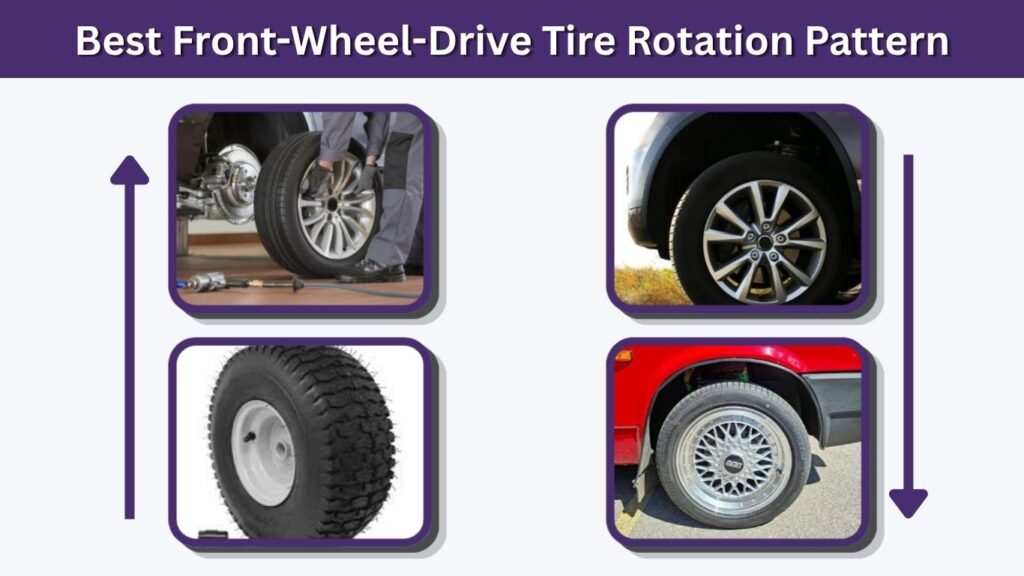
The standard pattern for a front-wheel-drive vehicle with four same-size, non-directional tires is the forward-cross pattern.
Forward-Cross Rotation
Move the tires as follows:
- Left front → left rear
- Right front → right rear
- Left rear → right front
- Right rear → left front
In simple terms, the front tires move straight backward, and the rear tires cross diagonally as they move forward. Michelin identifies this as a common FWD rotation method.
| Current position | New position |
| Left front | Left rear |
| Right front | Right rear |
| Left rear | Right front |
| Right rear | Left front |
This pattern gives the harder-working front tires time on the rear axle while changing the side of the former rear tires.
Can FWD Tires Use an X Pattern?
An X pattern moves every tire diagonally:
- Left front → right rear
- Right front → left rear
- Left rear → right front
- Right rear → left front
This pattern may be acceptable when all four tires are the same size and have non-directional tread. However, the forward-cross pattern is generally the most widely recommended arrangement for front-wheel-drive vehicles.
Follow the pattern listed in your owner’s manual when it differs from a general diagram.
Directional Tires on a Front-Wheel-Drive Car
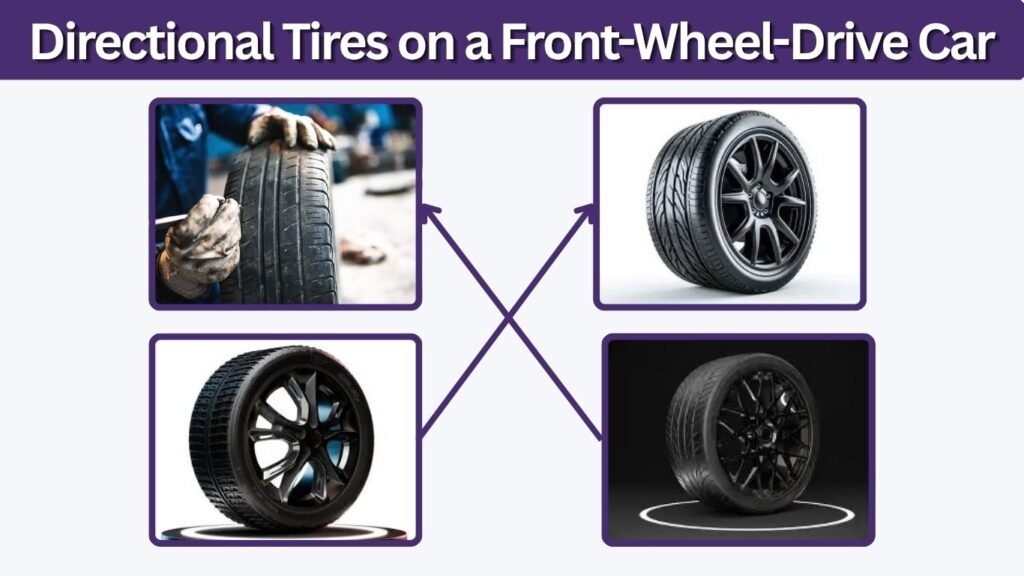
Directional tires are designed to rotate in only one direction. An arrow on the sidewall shows the correct direction of travel.
They should normally be rotated straight from front to rear without changing sides:
- Left front ↔ left rear
- Right front ↔ right rear
Crossing directional tires would make them rotate backward unless they were removed from their wheels and remounted. Michelin confirms that same-size directional tires can generally be rotated front to back while remaining on the same side.
Asymmetric and Staggered Tire Setups
Asymmetric tires have different inner and outer tread sections. Their sidewalls are usually marked “inside” and “outside.” If all four tires are the same size and not directional, they can often use the regular forward-cross pattern because the wheel’s outward-facing side remains outward after installation.
Staggered Wheels
A staggered setup uses different tire or wheel sizes on the front and rear axles. The larger rear tires usually cannot move to the front.
Possible rotation options include:
- Side-to-side rotation when the tires are non-directional
- No routine rotation when they are both staggered and directional
- Demounting and remounting by a tire professional
Staggered fitments restrict front-to-rear rotation because the wheel or tire dimensions differ between axles.
How Often Should FWD Tires Be Rotated?
Follow the interval in your vehicle owner’s manual or tire warranty. A common recommendation is around 5,000 to 8,000 miles, although specific manufacturers may prescribe shorter intervals.
Bridgestone advises following the vehicle manufacturer’s schedule or rotating around every 5,000 miles, while Goodyear publishes recommendations ranging from roughly 3,000 to 6,000 miles for some services.
Rotate sooner when you notice:
- Front tires wearing faster than the rear tires
- Feathered or uneven tread edges
- Increasing road noise
- Reduced wet-road traction
- Mild vibration or changes in handling
- A difference in tread depth between axles
Severe or unusual wear requires inspection because rotation alone will not fix its cause.
How to Rotate FWD Tires Safely
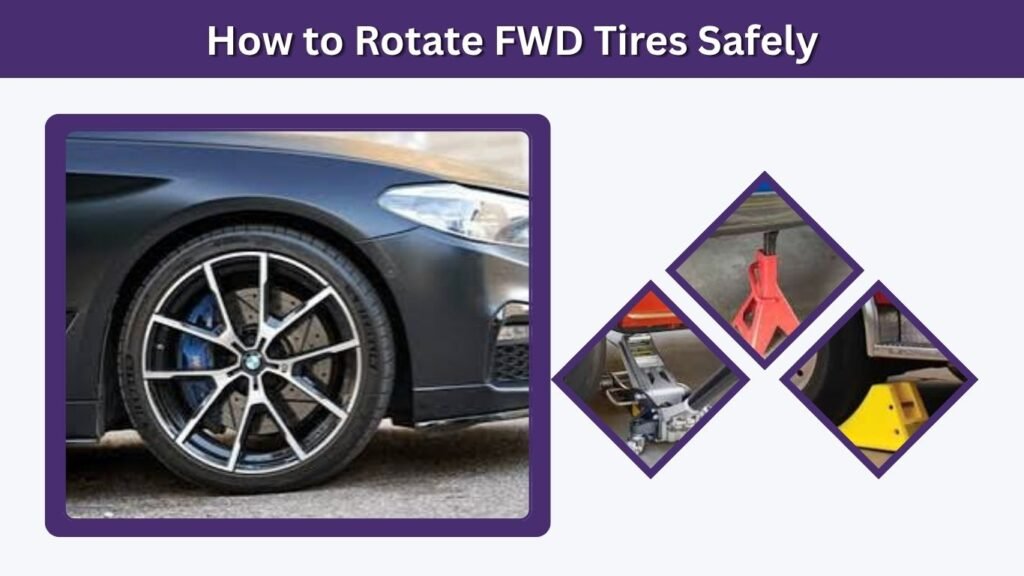
Rotating tires requires lifting the vehicle and supporting it securely. Consult the owner’s manual for approved lifting points, torque specifications, and any vehicle-specific instructions.
Equipment Needed
You may need:
- Floor jack with adequate capacity
- Properly rated jack stands
- Wheel chocks
- Lug wrench or breaker bar
- Torque wrench
- Tire-pressure gauge
- Chalk or labels for marking positions
Never work beneath or around a vehicle supported only by a jack.
Rotation Steps
- Park on a firm, flat surface and apply the parking brake.
- Place wheel chocks around tires remaining on the ground.
- Slightly loosen the lug nuts before lifting the vehicle.
- Raise the vehicle using its approved jacking points.
- Support it securely with properly positioned jack stands.
- Remove the wheels and inspect the tread and sidewalls.
- Move each tire according to the correct rotation pattern.
- Install the lug nuts by hand to prevent cross-threading.
- Lower the vehicle carefully.
- Tighten the lug nuts in a star or cross sequence using the specified torque.
Tightening in a cross sequence helps seat the wheel evenly, but the vehicle manufacturer’s torque specification must still be followed.
Checks to Perform After Rotation
Tire pressure requirements may differ between the front and rear axles. After rotation, set each tire to the pressure listed on the driver’s door placard for its new position.
Also check:
- Directional arrows face correctly
- “Inside” and “outside” markings remain properly oriented
- Lug nuts are correctly torqued
- Valve stems are undamaged
- Tires have no bulges, cuts, or exposed cords
- The tire-pressure monitoring system recognizes each position
Some TPMS systems must be reset or relearned after the wheels change positions. Bridgestone advises consulting the owner’s manual because rotation may affect the system.
Common FWD Tire Rotation Mistakes
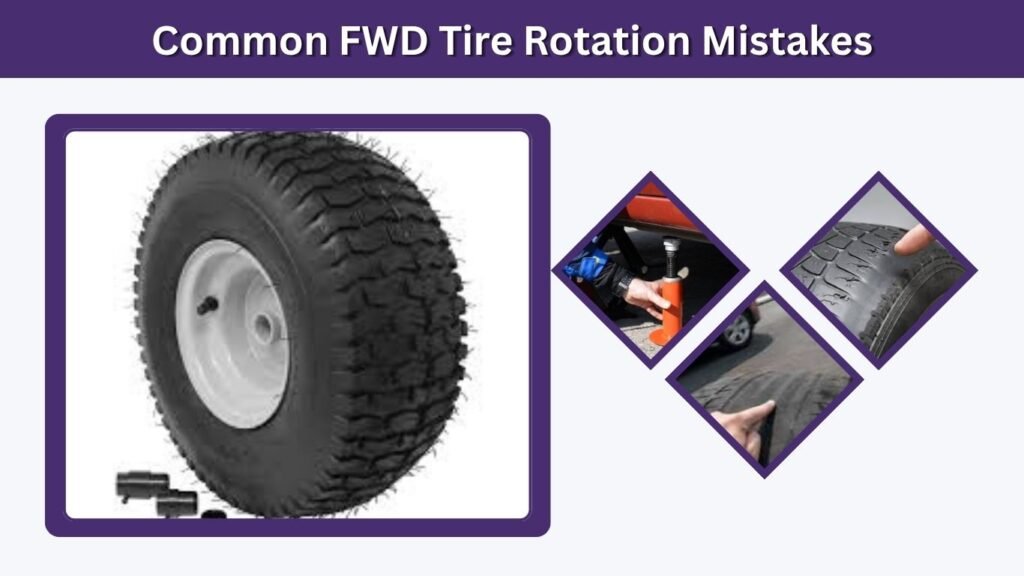
Crossing Directional Tires
Directional tires must remain on their designated sides unless professionally removed and remounted.
Ignoring Uneven Wear
Heavy shoulder wear, cupping, or rapid wear on one tire may indicate an alignment, inflation, suspension, or balance problem.
Using the Wrong Tire Pressure
Do not automatically keep the tire’s old pressure after moving it. Adjust it according to its new front or rear position.
Including a Temporary Spare
A compact temporary spare should not be included in a normal rotation. Only a matching full-size spare may be eligible, and the vehicle manufacturer’s five-tire pattern should be followed.
Relying Only on a Jack
A hydraulic or scissor jack is designed to lift the vehicle, not to provide stable long-term support while several wheels are removed.
FAQs
What is the proper tire rotation for front-wheel drive?
For same-size, non-directional tires, move both front tires straight to the rear. Cross the rear tires diagonally to the opposite front positions. This arrangement is known as the forward-cross pattern.
Do FWD tires have to be crossed?
Not always. Directional tires must normally remain on the same side and move only between the front and rear. Some vehicles may also specify a different pattern in the owner’s manual.
Can I rotate FWD tires front to back only?
Yes, particularly when the tires are directional. However, same-size non-directional tires generally use the forward-cross pattern so that the rear tires also change sides.
How often should FWD tires be rotated?
A common interval is every 5,000 to 8,000 miles, but the vehicle owner’s manual and tire warranty take priority. Rotate sooner when significant front-to-rear wear differences appear.
Should the better tires be on the front of a FWD car?
Despite the front wheels providing power, tire manufacturers commonly recommend keeping the deeper-tread or newer pair on the rear axle when only two tires are replaced. Better rear traction reduces the risk of rear-end instability on wet roads.