
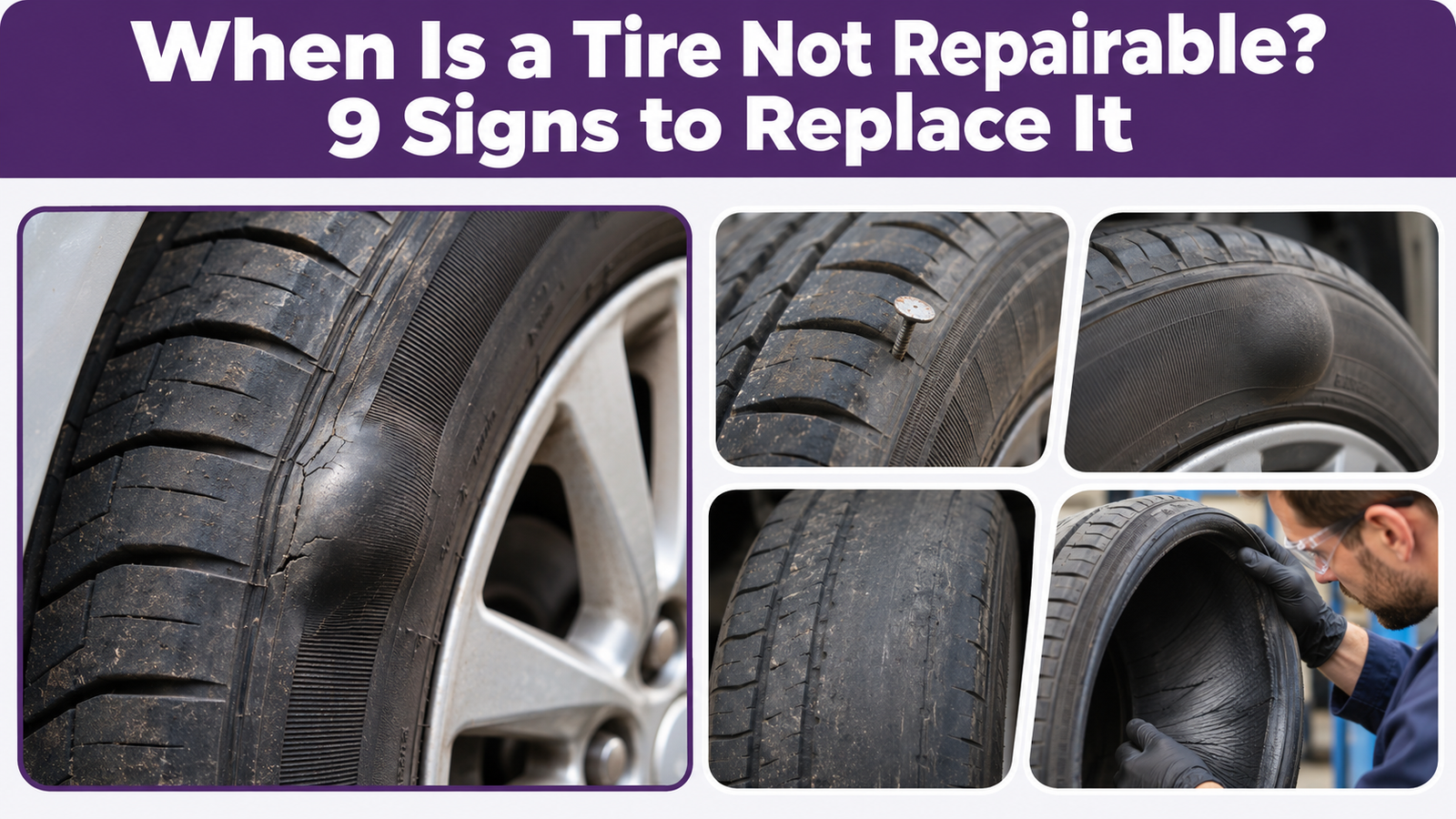
A nail in your tire does not always mean you need a replacement. Many small punctures can be repaired safely, but certain types of damage make a tire unsuitable for continued use. The location and size of the puncture, the tire’s condition, and whether you drove on it while flat all matter. So, when is a tire not repairable? This guide explains the warning signs, how to evaluate nail and screw punctures, and what a tire technician checks before recommending a repair or replacement.
When Is a Tire Not Repairable? 9 Warning Signs
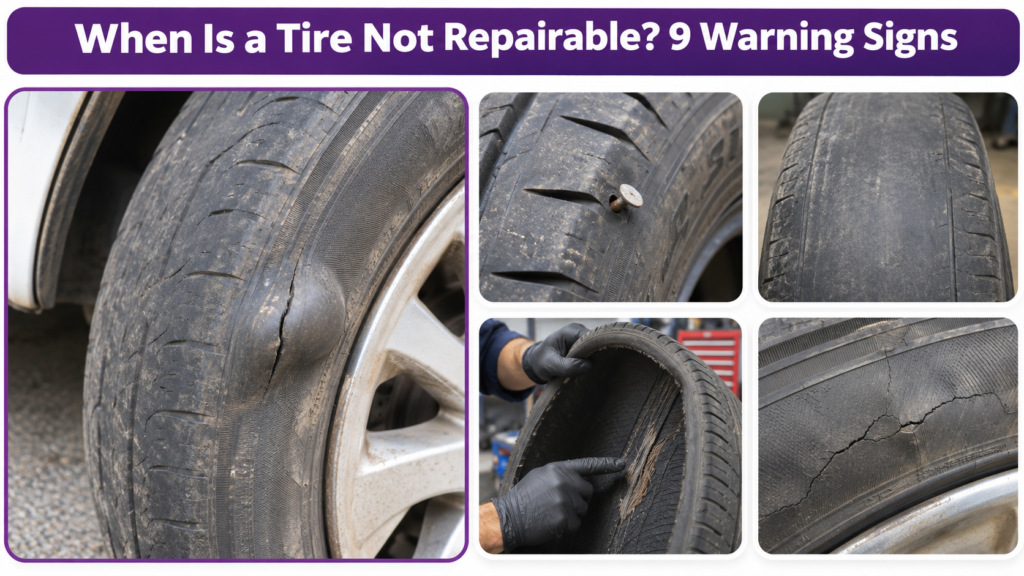
A tire is generally not repairable when damage reaches the shoulder or sidewall, a puncture exceeds 1/4 inch (6 mm), or its internal structure is compromised. Worn tread and old repairs can also prevent a repair. Manufacturer rules may be stricter than standard U.S. guidance.
1. The Puncture Is in the Sidewall
The sidewall flexes constantly while driving. A patch in this area cannot reliably withstand those forces. Replace a tire with a sidewall nail hole, cut, or tear, even if the opening appears small.
2. The Damage Is on the Tire Shoulder
The shoulder connects the tread to the sidewall and sits outside the approved repair zone. Even a small hole at the tread’s outer edge can reach the shoulder or belt edge. If the injury reaches this area, replace the tire.
3. The Puncture Is Larger Than 1/4 Inch
The recommended puncture limit for passenger and light-truck tires is 1/4 inch (6 mm). Large bolts or road debris may exceed it. A small-looking outside hole can hide a wider injury, so the technician must inspect the actual damage channel.
4. The Tire Was Driven While Flat
Driving with little or no air can crush the sidewalls, generate heat, and break internal cords. Rubber dust, wrinkling, or abrasion inside the tire are warning signs. Once its structure is damaged, reinflation cannot restore safety.
5. There Is a Bulge or Bubble
A bulge or blister suggests broken cords or separated layers, often after a pothole or curb strike. This is structural damage, not a simple air leak. Avoid driving on a bulging tire and have it replaced promptly.
6. Internal Cords or the Inner Liner Are Damaged
Exposed reinforcement cords, separated belts, major cuts, or damaged inner liners can make repair unsafe. Many defects remain hidden until the tire is removed from the wheel. A plug installed from outside cannot establish whether the internal structure is sound.
7. A New Repair Would Overlap an Old One
Multiple punctures are not automatically disqualifying, but repairs must not overlap. Injuries directly opposite each other may also rule out repair. Under U.S. industry guidance, tires with existing improper repairs must be removed from service.
8. The Tread Is Too Worn
The Tire Industry Association advises against repairing a tire worn to 2/32 inch (1.6 mm) of tread depth anywhere on its tread. Worn tires have reduced grip and little remaining life. Replace them even if a nail hole looks repairable.
9. The Tire Has Serious Cracking or Age-Related Damage
Deep cracks, brittle rubber, or separation can make a tire unsafe. Age alone is not a universal rejection rule, but manufacturers set service-life guidance. Michelin recommends professional inspection after five years in use and replacement by ten years from manufacture.
When Is a Nail or Screw in a Tire Not Repairable?
Nails and screws can cause small repairable punctures, but the object’s type matters less than its location, injury size, and resulting pressure loss. An embedded object does not guarantee the tire is safe.
When Is a Nail in a Tire Not Repairable?
A nail puncture generally requires replacement when:
- It passes through the sidewall, shoulder, or belt-edge area.
- Its actual damage channel exceeds 1/4 inch (6 mm).
- The tire was driven flat or has hidden internal damage.
- A repair would overlap an existing repair, or the tread is worn out.
A small central-tread nail hole may qualify if the casing is sound. The nail’s head does not reveal the injury’s full extent.
When Is a Screw in a Tire Not Repairable?
The same limits apply to screws. A shallow screw may not penetrate fully, whereas a longer one can damage internal layers.
A shoulder puncture remains nonrepairable regardless of patch size. Leave an embedded screw in place until a technician can inspect it, unless roadside circumstances require otherwise.
When Is a Flat Tire or Tire Puncture Still Repairable?
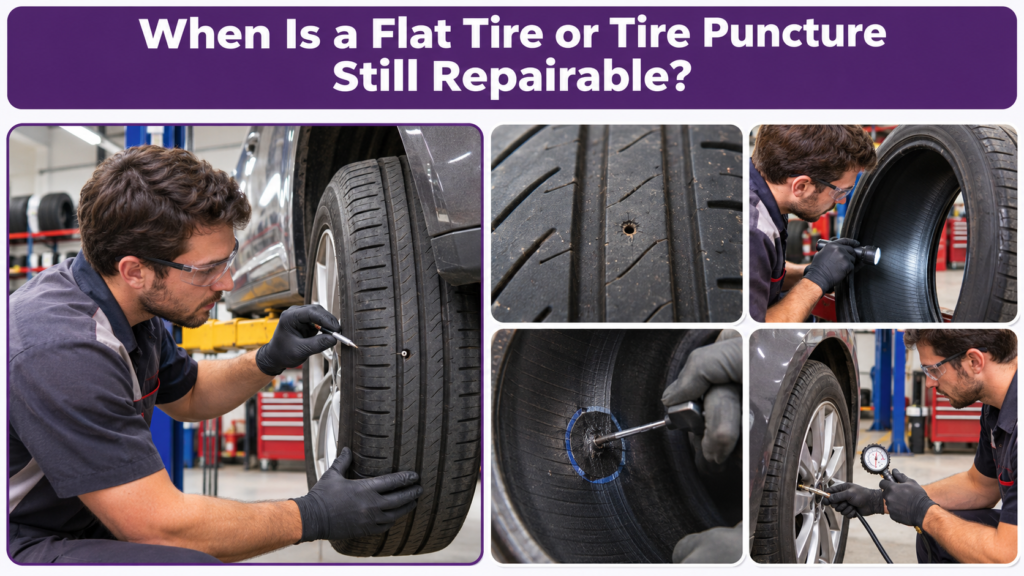
A flat tire is not necessarily ruined. If you stopped promptly and the leak came from a small central-tread puncture, repair may still be possible. An outside inspection alone cannot confirm its safety.
Conditions That Favor a Safe Repair
A tire is a potential repair candidate when all of the following apply:
- The hole is entirely within the central tread repair zone.
- The puncture injury measures no more than 1/4 inch (6 mm).
- There is no run-flat damage, bulge, exposed cord, or serious cracking.
- Existing repairs do not overlap the new injury.
- The tread has more than 2/32 inch of remaining depth.
- The tire manufacturer permits repair of that particular tire.
These are screening criteria, not an automatic repair approval.
What About Run-Flat Tires?
Run-flat tires have reinforced construction but can still suffer hidden internal damage. Some manufacturers allow limited repairs; others prohibit repair after significant pressure loss.
Follow the exact tire maker’s policy. Replace a run-flat if its condition cannot be verified.
How Does a Professional Tire Repair Work?
A proper repair seals both the puncture channel and airtight inner liner. A quick outside string plug does not permit an internal inspection.
U.S. industry guidance requires removing and inspecting the tire before a permanent combination repair.
Inspection and Proper Repair Steps
- Remove the tire from the wheel to reveal the inner surface.
- Inspect the casing for rubbing, cord damage, separation, and other hidden problems.
- Check puncture size and location against the approved repair area and manufacturer policy.
- Install a combination patch-and-plug from inside, filling the injury channel and sealing the inner liner.
- Reinflate and check for leaks before returning the tire to service.
Sealant and outside-only plugs are not permanent substitutes.
What Should You Do if Your Tire Might Be Beyond Repair?
If a tire is visibly flat, bulging, or making the car unstable, pull over safely. Do not test how far it can travel. Arrange professional inspection or assistance.
- Stop in a safe place and turn on the hazard lights if appropriate.
- Avoid pulling out an embedded nail or screw before inspection.
- Use a suitable spare tire or roadside assistance if driving is unsafe.
- Ask the shop to explain the exact reason a repair is not approved.
For replacement, match the vehicle’s tire size and ratings. All-wheel-drive vehicles may require closely matched tread depths; check the owner’s manual before replacing just one tire.
Tire Repair vs. Replacement: Quick Comparison
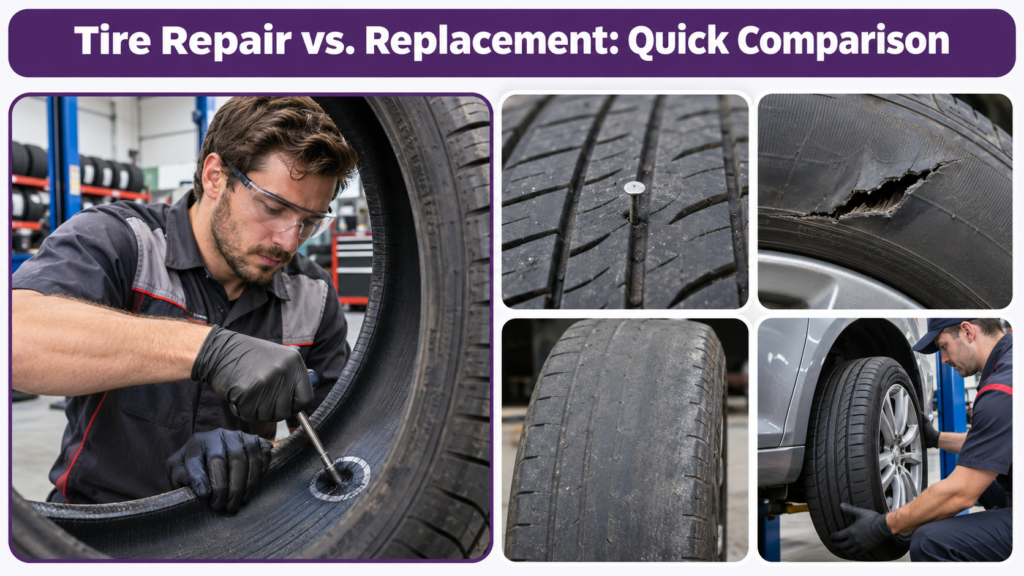
A small central-tread puncture may be fixable; damage affecting tire strength usually is not. This U.S.-focused comparison summarizes typical decisions, subject to inspection and manufacturer limits.
| Tire condition | Typical recommendation |
| Small nail in the central tread, sound casing | Repair may be possible |
| Screw through shoulder or sidewall | Replace tire |
| Puncture larger than 1/4 inch (6 mm) | Replace tire |
| Driven flat with internal damage | Replace tire |
| Bulge, exposed cords, or separation | Replace tire |
| Tread at or below 2/32 inch | Replace tire |
| New puncture overlaps previous repair | Replace tire |
FAQs
1. Can a tire be repaired if the nail is close to the sidewall?
Not if the injury reaches the shoulder or belt edge. An outer-tread hole can extend into a prohibited repair zone, so a technician must inspect its actual path.
2. Is a tire repairable after driving on it flat?
Only if inspection confirms no structural damage and all repair criteria are met. Driving on little or no air can cause invisible damage, making replacement necessary.
3. Can you repair a tire with two nails in it?
Possibly, if both injuries meet the limits and repairs do not overlap. Multiple punctures require careful inspection, and the manufacturer may impose additional restrictions.
4. Is a tire plug enough for a permanent repair?
No. A plug alone does not seal the inner liner; a patch alone does not fill the injury channel. A permanent repair requires both functions after inspection.
5. Should I replace a tire if it keeps losing air after a repair?
Have it checked promptly. The leak might come from an old repair, another puncture, the valve, or the wheel. Repeatedly driving underinflated can cause irreversible damage.