
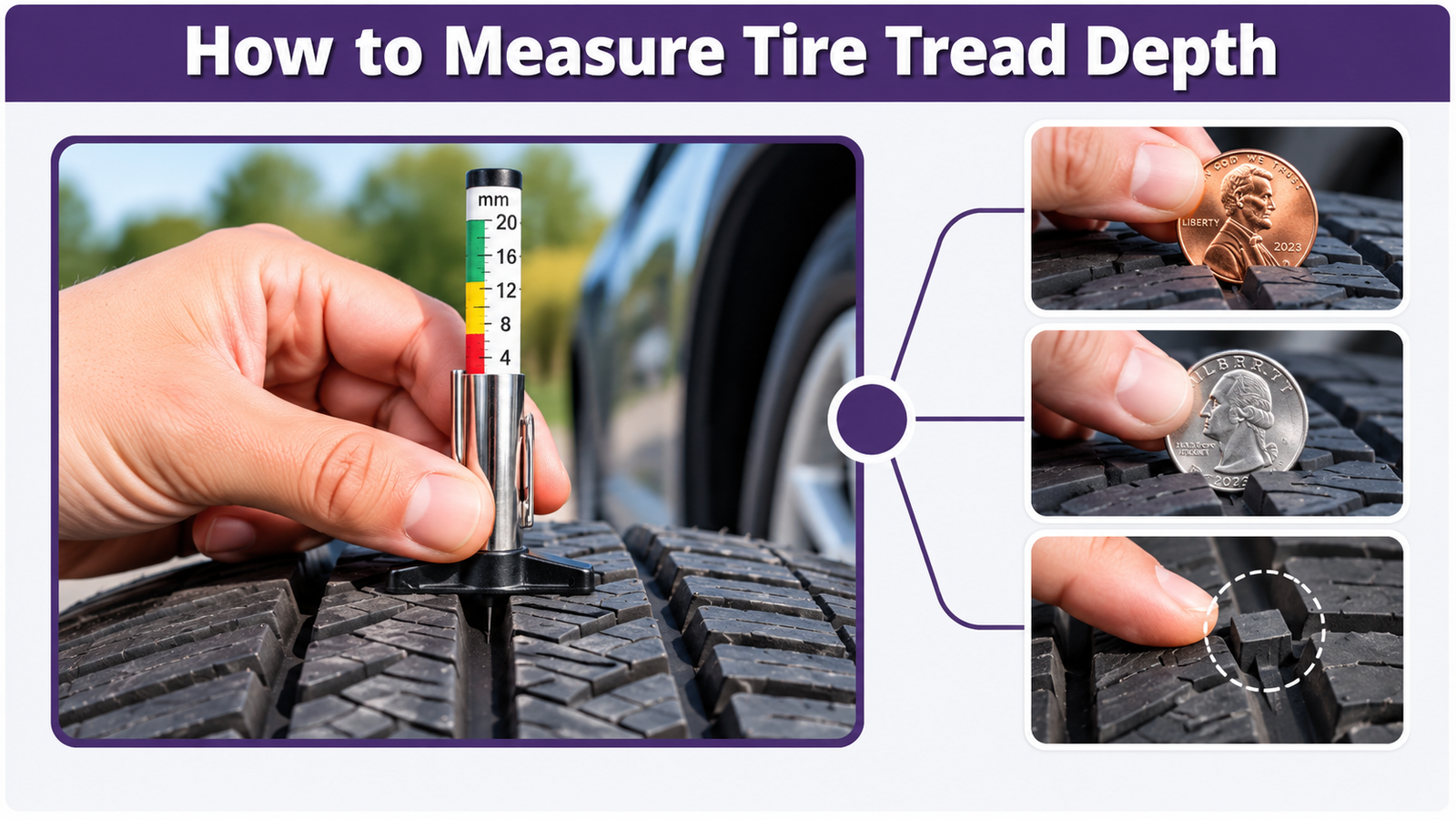
Knowing how to measure tire tread depth is essential for keeping your vehicle safe and maintaining proper traction on the road. Tire tread gradually wears down with regular driving, reducing its ability to grip wet, snowy, or slippery surfaces. Measuring tread depth helps you identify worn tires before they become dangerous. You can check tire tread depth using a dedicated gauge, a penny, a quarter, or built-in wear indicators. This guide explains how to measure tire tread depth accurately, understand the readings, and determine when tire replacement is necessary.
What Is Tire Tread Depth?
Tire tread depth is the measurement between the top surface of a tire’s tread blocks and the bottom of its main grooves. These grooves help move water away from the tire’s contact area, improving traction and vehicle control.
Tread depth is measured in millimeters or 32nds of an inch. Most new passenger-car tires have tread depths ranging from approximately 9/32 to 11/32 inch, depending on the tire model and design.
Measuring tread depth regularly provides several advantages:
- Improved traction: Helps identify tires that may struggle to grip wet roads.
- Better braking performance: Reduces the risk associated with excessive tread wear.
- Early wear detection: Reveals uneven wear caused by alignment or inflation issues.
- Tire replacement planning: Helps determine when new tires may be needed.
Tools Needed to Measure Tire Tread Depth
Before measuring your tires, choose an appropriate measuring tool. Different tools offer different levels of accuracy.
| Tool | Measurement Type | Accuracy |
|---|---|---|
| Tire tread depth gauge | Exact numerical reading | High |
| Digital tread depth gauge | Digital numerical reading | High |
| U.S. penny | Approximate 2/32-inch threshold | Limited |
| U.S. quarter | Approximate 4/32-inch threshold | Limited |
| Built-in wear indicators | Replacement-limit indication | Limited |
A tire tread depth gauge is the best choice when you need precise measurements. Coin tests and wear indicators are useful for quick inspections but cannot identify every level of tread wear.
How to Measure Tire Tread Depth With a Gauge
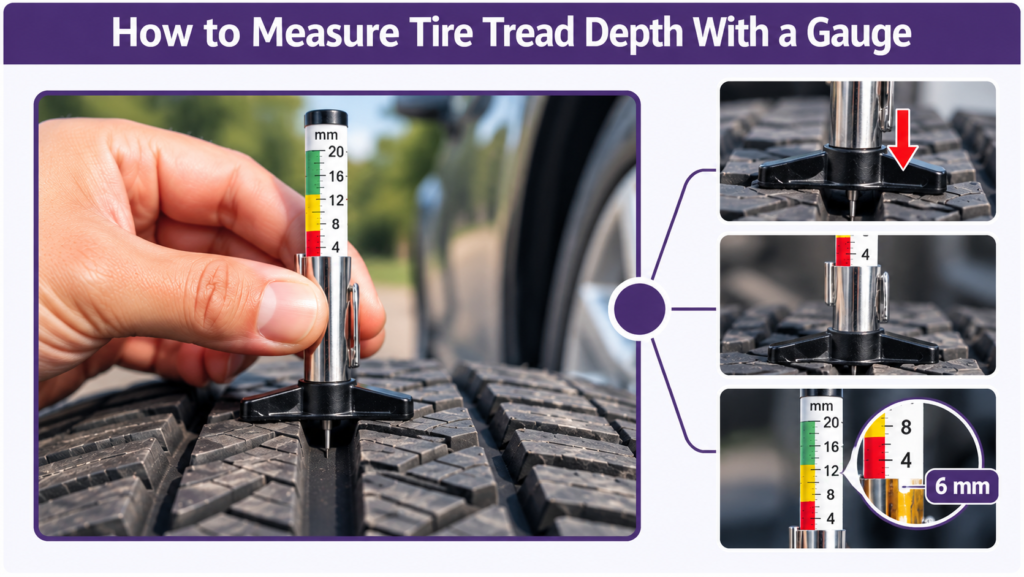
A tire tread depth gauge is one of the most reliable tools for measuring tire wear. It provides numerical readings that help you track tread depth over time.
Step 1: Park Your Vehicle Safely
Park your vehicle on a level surface, turn off the engine, and engage the parking brake.
Make sure the tires are stationary and easily accessible. Remove any dirt, small stones, or debris from the grooves before measuring.
Step 2: Prepare the Tread Depth Gauge
Check that the gauge is clean and functioning correctly.
For a mechanical gauge, press its base against a flat surface to confirm it reads zero. Digital gauges should be switched on and zeroed according to the manufacturer’s instructions.
Step 3: Insert the Gauge Into the Tread Groove
Position the gauge’s measuring probe inside a main tread groove.
Lower the probe until it touches the groove’s bottom, keeping the gauge’s base flat against the surrounding tread blocks.
Avoid placing the probe directly on a raised tread wear indicator because this can produce an incorrect reading.
Step 4: Read the Measurement
Once the gauge is properly positioned, read the displayed depth.
Mechanical gauges commonly show measurements in 32nds of an inch, while digital models may display inches or millimeters.
For example, a reading of 6/32 inch equals approximately 4.8 mm.
Step 5: Measure Multiple Tire Locations
Check the inner, center, and outer tread areas. Repeat these measurements at several points around the tire.
Record the lowest valid reading because one part of the tire may wear faster than another.
Repeat the process on all four tires for a complete inspection.
How to Measure Tire Tread Depth With a Penny
The penny test provides a quick way to check whether your tire has reached approximately 2/32 inch of tread depth.
This method works with a U.S. penny featuring Abraham Lincoln.
Follow these steps:
- Take a penny and hold it with Lincoln’s head facing downward.
- Insert the penny into one of the tire’s main tread grooves.
- Keep Lincoln’s head facing toward you.
- Observe how much of his head remains visible.
- Repeat the test across several locations.
If the tread covers part of Lincoln’s head, the depth is greater than approximately 2/32 inch at that location.
If the top of his head is visible, the tire has reached the replacement threshold.
The penny test is convenient but does not provide an exact numerical measurement.
How to Measure Tire Tread Depth With a Quarter
The quarter test is another useful technique for estimating tread depth.
A U.S. quarter featuring George Washington can help determine whether a tire has approximately 4/32 inch of tread remaining.
To perform the test:
- Hold the quarter with Washington’s head pointing downward.
- Insert it into a main tread groove.
- Check whether the tread covers the top of Washington’s head.
- Repeat the measurement across the tire.
If the top of Washington’s head is visible, the tread is approximately 4/32 inch or less.
At this depth, tires may experience reduced wet-road traction. Consider planning a replacement, especially if you frequently drive in heavy rain.
How to Measure Tire Tread Depth Without a Tool
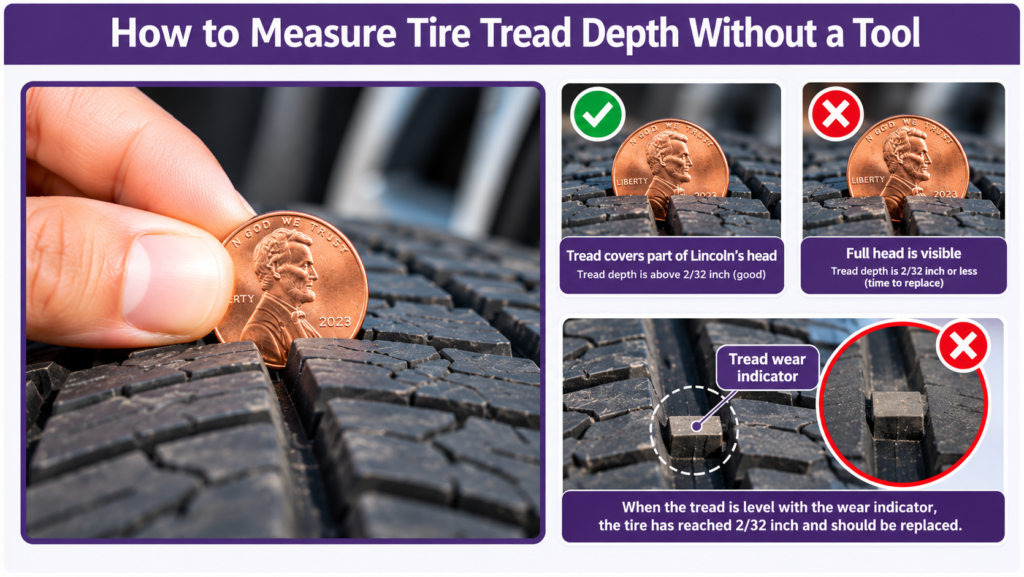
Most passenger-car tires contain built-in tread wear indicators. These are small raised rubber bars positioned across the main grooves.
They offer a convenient way to identify tires that have reached their minimum recommended tread depth.
Locate the raised bars and compare their height with the surrounding tread blocks.
If the tread surface is level with the wear indicators, the tire has typically reached 2/32 inch and should be replaced.
These indicators do not provide intermediate measurements, so they cannot tell you whether your tire has 5/32 or 7/32 inch remaining.
Tire Tread Depth Measurement Chart
The following chart helps you interpret common tread depth measurements for passenger-car tires.
| Tread Depth | Millimeters | General Condition |
|---|---|---|
| 10/32 inch | 7.9 mm | Typical new-tire depth |
| 8/32 inch | 6.4 mm | Good tread remaining |
| 7/32 inch | 5.6 mm | Moderate wear |
| 6/32 inch | 4.8 mm | Usable tread remaining |
| 5/32 inch | 4.0 mm | Monitor wear |
| 4/32 inch | 3.2 mm | Consider wet-weather replacement |
| 3/32 inch | 2.4 mm | Replace soon |
| 2/32 inch | 1.6 mm | Replace immediately |
These values are general guidelines. Actual tire performance depends on tire design, road conditions, weather, and vehicle characteristics.
How to Measure Tire Tread Depth in Millimeters
Tire tread depth can be expressed in either inches or millimeters. Understanding both units makes it easier to compare tire measurements and manufacturer recommendations.
One inch equals 25.4 millimeters.
To convert tread depth from 32nds of an inch into millimeters, multiply the numerator by 25.4 and divide by 32.
For example:
\[ \frac{6}{32}\times25.4=4.76\text{ mm} \]
Therefore, a tread depth of 6/32 inch equals approximately 4.8 mm.
If your digital depth gauge offers both measuring units, you can simply switch between inches and millimeters without calculating manually.
Common Mistakes When Measuring Tire Tread Depth
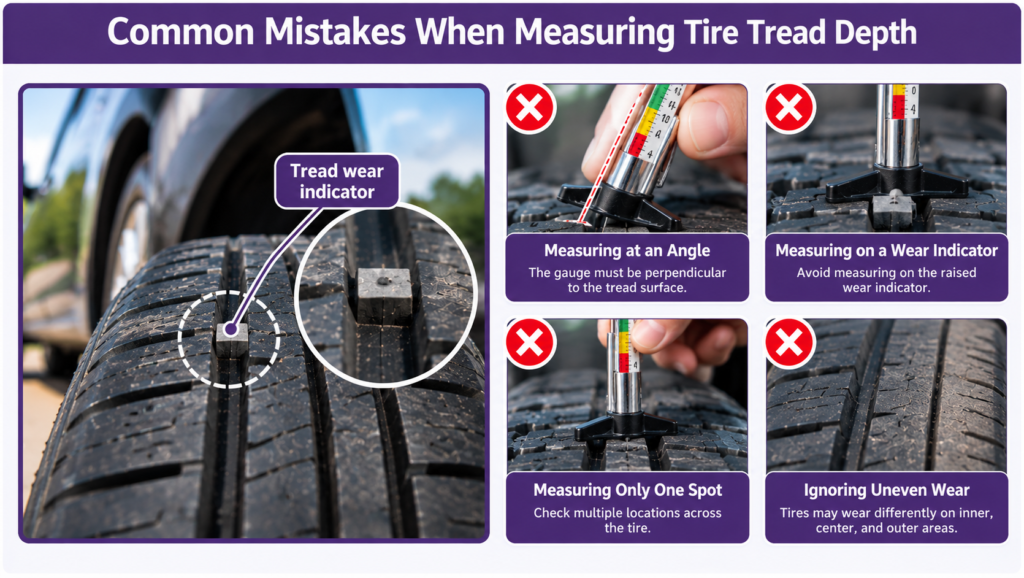
Even with a reliable measuring tool, certain mistakes can lead to inaccurate readings.
Measuring Only One Spot
Tires do not always wear evenly. Checking only one groove may overlook excessive wear elsewhere.
Measure several locations across the tread width and around the tire circumference.
Placing the Gauge Incorrectly
A gauge positioned at an angle or resting on a raised wear bar may produce inaccurate results.
Keep the gauge perpendicular to the tread surface and ensure its measuring probe reaches the bottom of the groove.
Ignoring Uneven Tire Wear
Uneven wear may indicate incorrect tire pressure, wheel alignment problems, or suspension issues.
When significant differences appear between measurements, have the vehicle inspected professionally.
Measuring Between Tread Blocks Incorrectly
Tread depth should be measured inside the main circumferential grooves rather than random surface patterns or shallow decorative sipes.
Using consistent measuring locations improves accuracy and makes future comparisons easier.
How Often Should You Measure Tire Tread Depth?
Tire tread depth should be checked at least once a month and before long journeys.
Regular measurements help monitor tire wear and identify developing problems.
Consider measuring more frequently if you regularly drive long distances, travel on rough roads, or notice changes in vehicle handling.
Record the measurements for each tire to compare them during future inspections.
Checking tire pressure and tread condition together is an effective way to maintain tires and detect problems early.
When Should You Replace Tires Based on Tread Depth?
Tire replacement should be considered before the tread becomes dangerously shallow.
In the United States, 2/32 inch is the commonly used minimum for passenger-car tires, although local legal requirements can differ.
However, tires with 4/32 inch remaining may already demonstrate reduced performance on wet roads.
Drivers who frequently encounter rain should consider earlier replacement, while winter driving may require even deeper tread.
Also inspect tires for cracks, bulges, exposed cords, and other damage, because tread depth alone cannot determine whether a tire is safe.
Frequently Asked Questions
1. What is the most accurate way to measure tire tread depth?
A calibrated tire tread depth gauge provides the most accurate measurement. Both mechanical and digital gauges can measure the distance between the tread surface and groove bottom.
2. How do you read a tire tread depth gauge?
Place the gauge’s probe into a main tread groove and rest its base flat against the surrounding tread blocks. Read the measurement in millimeters or 32nds of an inch, depending on the gauge.
3. Is 6/32 tire tread depth good?
A tread depth of 6/32 inch generally indicates usable tread remaining on a passenger-car tire. However, overall safety depends on the tire’s condition, design, and driving environment.
4. Can you measure tire tread depth with a ruler?
A ruler with fine millimeter markings can provide a rough estimate if positioned correctly inside a groove. However, a dedicated tire tread depth gauge provides more reliable measurements.
5. What is the minimum tire tread depth in millimeters?
The commonly used minimum tread depth for U.S. passenger-car tires is 1.6 mm, equivalent to 2/32 inch. Tires reaching this measurement should be replaced, regardless of whether other areas have deeper tread.