
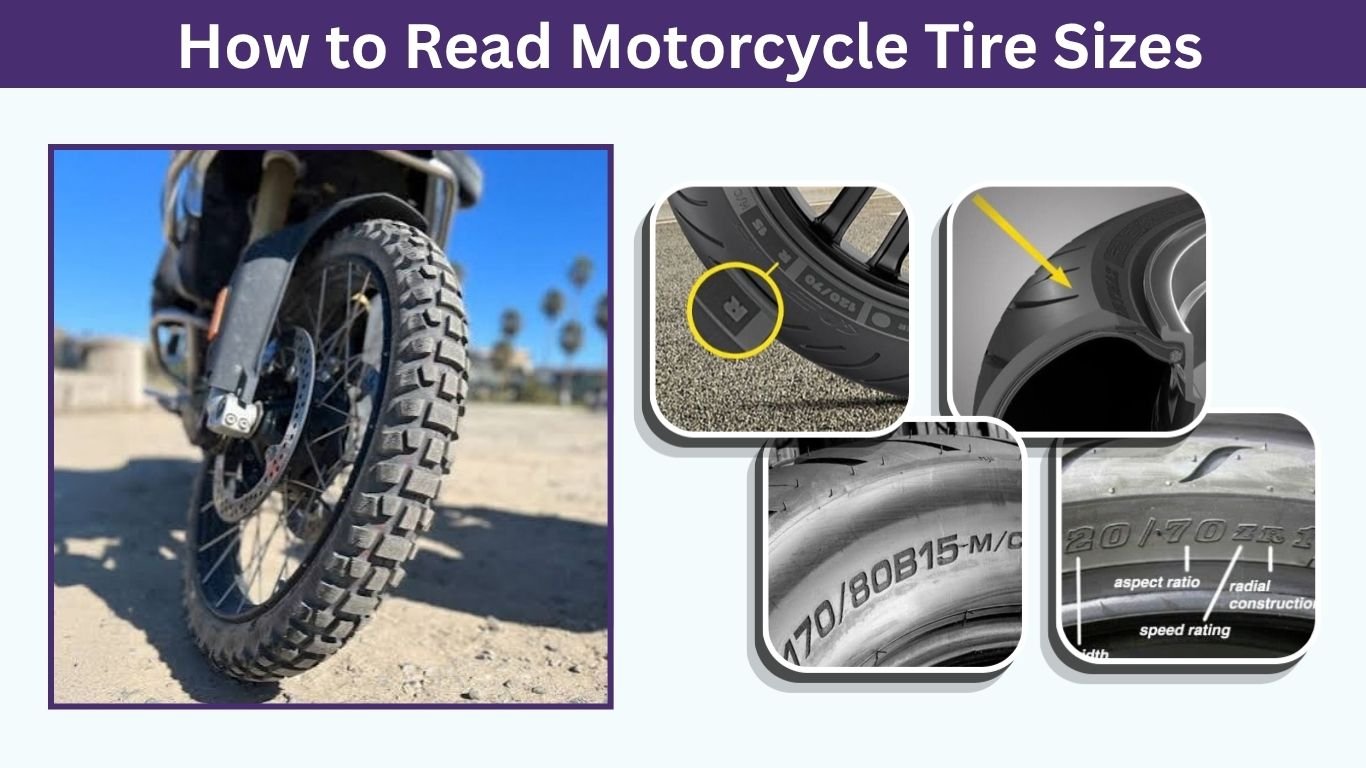
Learning how to read motorcycle tire size makes it easier to choose the correct replacement tires and understand how your bike is designed to perform. Motorcycle tire sidewalls contain numbers and letters that describe tire width, aspect ratio, construction type, wheel diameter, load capacity, and speed rating. A code such as 120/70 ZR17 58W may seem complicated at first, but each section has a clear meaning. Once you understand these markings, checking motorcycle tire size becomes simple and practical.
Where to Find Your Motorcycle Tire Size
Before decoding motorcycle tire numbers, you need to locate the correct tire specification. The size is usually printed clearly on the sidewall, but your motorcycle manufacturer also provides recommended front and rear sizes. Checking the manufacturer’s information is important because the front and rear tires commonly have different dimensions and performance requirements.
Check the Tire Sidewall
Look along the sidewall of your motorcycle tire for a marking similar to:
120/70 ZR17 58W
The marking may appear alongside the tire brand, model name, construction information, and other safety codes.
Check the Owner’s Manual
Your motorcycle owner’s manual usually lists the manufacturer’s recommended front and rear tire specifications.
It may include:
- Front tire size
- Rear tire size
- Recommended tire pressure
- Approved load ratings
- Recommended speed ratings
These specifications should be your main reference when selecting replacement tires.
Check the Motorcycle Information Label
Many motorcycles have an information sticker or plate located near the frame, swingarm, chain guard, or under the seat. Depending on the motorcycle, this label may show tire dimensions and recommended inflation pressures.
How to Read Motorcycle Tire Size Numbers
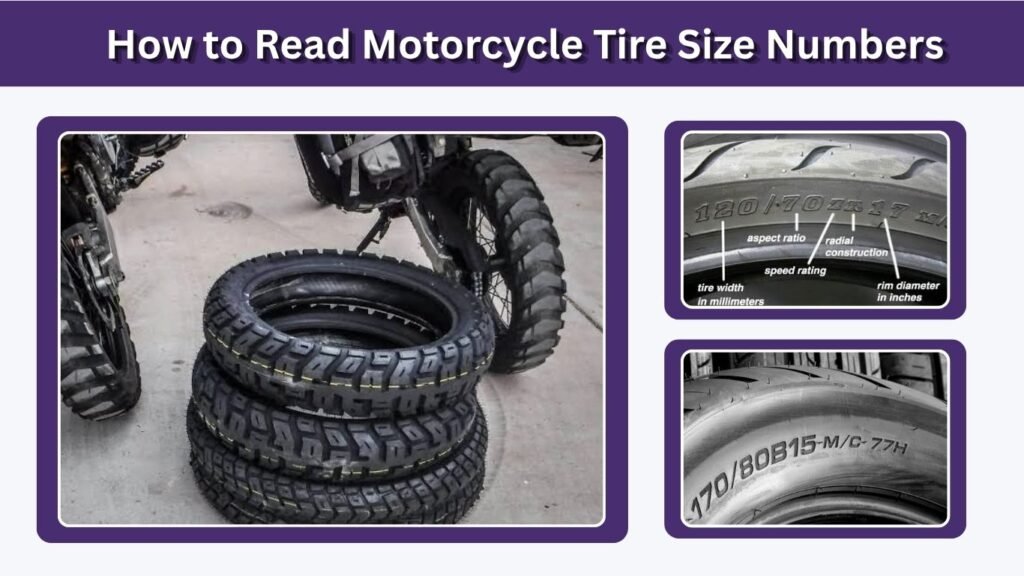
The most common modern motorcycle tires use metric sizing. Consider the example 120/70 ZR17 58W. Instead of viewing the marking as one complicated code, separate it into individual parts. Each number and letter provides information about tire dimensions, construction, load capacity, or performance.
120 – Tire Width
The first number represents the nominal width of the tire in millimeters.
In:
120/70 ZR17
the 120 means the tire is approximately 120 millimeters wide.
Wider tires may provide a larger contact area, but tire width must be compatible with the motorcycle’s wheel and available clearance.
70 – Aspect Ratio
The second number is the tire’s aspect ratio.
In 120/70, the number 70 means the sidewall height is approximately 70% of the tire’s width.
For example:
120 × 0.70 = 84 mm
Therefore, the approximate sidewall height is 84 millimeters.
A lower aspect ratio generally produces a shorter sidewall, while a higher ratio creates a taller sidewall.
ZR – Speed Category and Construction
The letters between the aspect ratio and wheel diameter provide additional information.
In 120/70 ZR17:
- Z indicates a high-speed performance category.
- R means radial construction.
Radial tires are common on modern sport, touring, and performance motorcycles.
You may also see a B, which can indicate bias-belted construction, or no R on some conventional bias-ply motorcycle tires.
17 – Wheel Diameter
The number after the construction marking represents wheel diameter in inches.
Therefore:
120/70 ZR17 = designed for a 17-inch wheel
The wheel diameter must match the tire specification. A tire designed for a 17-inch rim cannot simply be mounted on an 18-inch rim.
Motorcycle Tire Size Example Explained
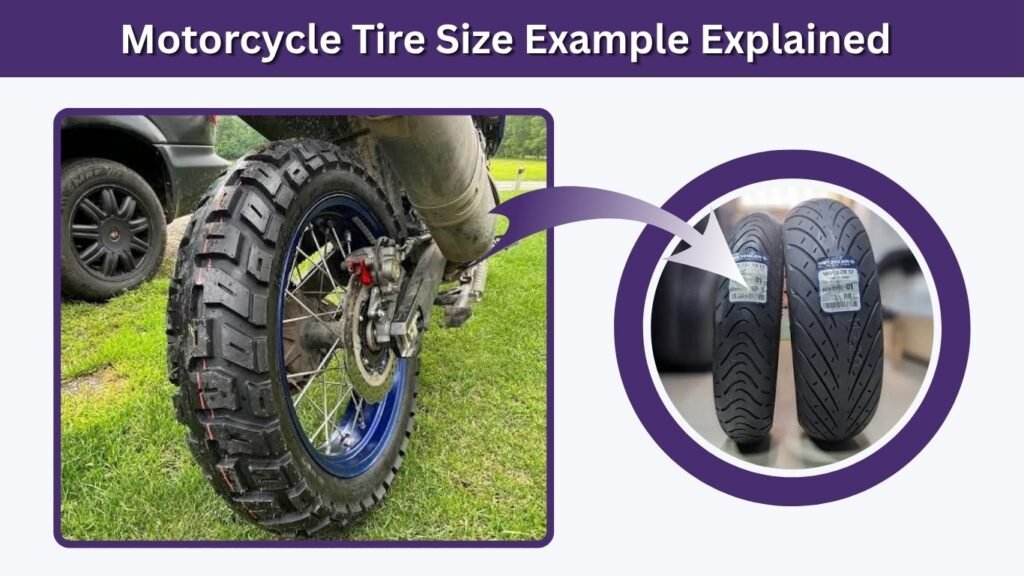
Looking at a complete example is one of the easiest ways to understand how to read a motorcycle tire size. Suppose the sidewall displays 120/70 ZR17 58W. Every section has a different purpose, allowing you to identify the physical tire dimensions and important performance classifications.
Breaking Down 120/70 ZR17 58W
The marking can be understood as follows:
- 120: Nominal tire width in millimeters
- 70: Sidewall height is 70% of tire width
- Z: High-speed category designation
- R: Radial tire construction
- 17: Fits a 17-inch wheel
- 58: Load index
- W: Speed rating
Once you memorize this basic pattern, reading most metric motorcycle tire sizes becomes much easier.
Front and Rear Tire Sizes
Motorcycles usually use different front and rear tire dimensions.
For example, a motorcycle might use:
Front: 120/70 ZR17
Rear: 180/55 ZR17
The rear tire is considerably wider because it handles power delivery and a large portion of the motorcycle’s load. The front tire is typically narrower to support responsive steering.
You should not assume that the front and rear tires should be the same size.
Motorcycle Tire Load Index and Speed Rating
After the main tire dimensions, you may see another number followed by a letter, such as 58W. These markings are important when choosing replacement tires because they indicate how much weight the tire is designed to support and its standardized speed capability under specified operating conditions.
Understanding the Load Index
In 58W, the number 58 represents the tire’s load index.
The number corresponds to a standardized maximum load capacity rather than directly representing kilograms.
Examples include:
- 54: approximately 212 kg
- 58: approximately 236 kg
- 69: approximately 325 kg
- 73: approximately 365 kg
- 75: approximately 387 kg
The tire’s load capacity should meet or exceed the motorcycle manufacturer’s requirements.
Understanding the Speed Rating
The final letter indicates the tire’s speed rating.
Some common motorcycle tire speed ratings include:
- P: Up to 150 km/h
- S: Up to 180 km/h
- H: Up to 210 km/h
- V: Up to 240 km/h
- W: Up to 270 km/h
A speed rating reflects standardized testing capability. It should never be interpreted as permission to ride at that speed.
Metric, Inch, and Alphanumeric Motorcycle Tire Sizes
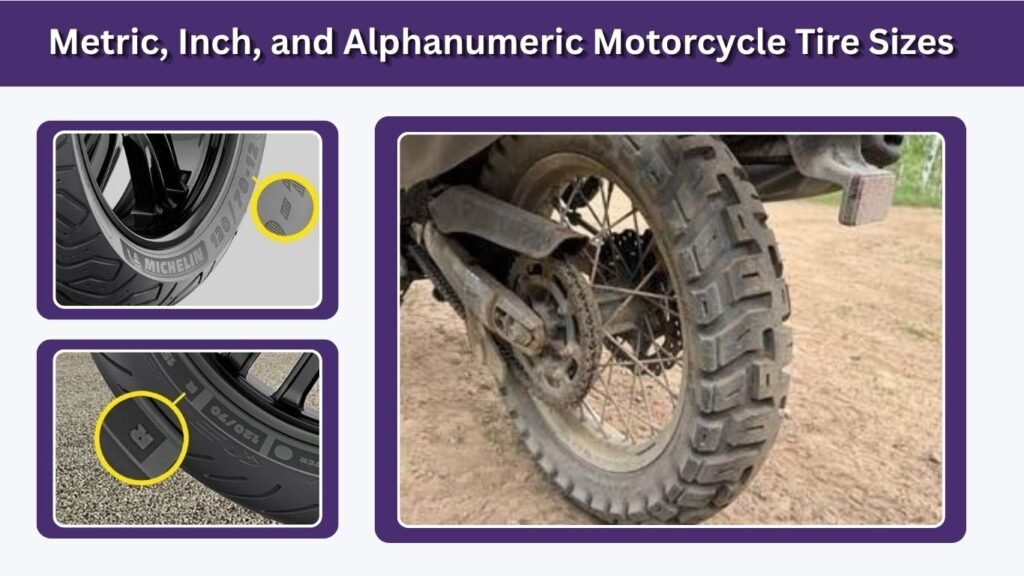
Not every motorcycle uses the modern metric format. Classic motorcycles, cruisers, scooters, and older bikes may use inch-based or alphanumeric sizing systems. Understanding these different formats can help when comparing older motorcycle specifications with modern replacement tires.
Metric Motorcycle Tire Sizes
Metric sizing is the most common modern system.
An example is:
150/70 R17
This means the tire is approximately 150 mm wide, has a sidewall height equal to 70% of its width, uses radial construction, and fits a 17-inch wheel.
Inch-Based Tire Sizes
Some older or classic motorcycles may display tire dimensions such as:
3.50-18
The first number generally refers to the approximate tire width in inches, while the second number identifies the wheel diameter.
Exact compatibility should always be checked using the motorcycle and tire manufacturer’s specifications.
Alphanumeric Tire Sizes
Some tires use markings such as MT90-16 or similar combinations.
These sizing systems use letters and numbers to represent tire dimensions and wheel fitment. Because conversions between alphanumeric and metric sizes are not always exact, use a reputable motorcycle tire conversion chart before selecting a replacement.
Other Important Motorcycle Tire Markings
Besides tire size, motorcycle sidewalls contain several other codes that provide information about manufacturing date, rotation direction, construction, and suitability. These markings are worth checking whenever you inspect or replace motorcycle tires because motorcycle handling depends heavily on proper tire installation and condition.
DOT Manufacturing Date
A DOT identification code often ends with four digits representing the week and year of manufacture.
For example:
2426
means the tire was manufactured during the 24th week of 2026.
The manufacturing date helps riders evaluate tire age alongside physical condition and manufacturer guidance.
Rotation Arrow
Many motorcycle tires are directional.
Look for an arrow on the sidewall showing the required direction of rotation. Installing a directional tire backward can affect water evacuation, handling characteristics, and intended tire performance.
Always follow the arrow when mounting the tire.
Tubeless or Tube Type
A motorcycle tire may be marked:
- TL: Tubeless
- TT: Tube type
The correct setup depends on both the tire and wheel design. Do not assume every modern-looking motorcycle tire can be used without an inner tube.
How to Choose the Correct Motorcycle Tire Size
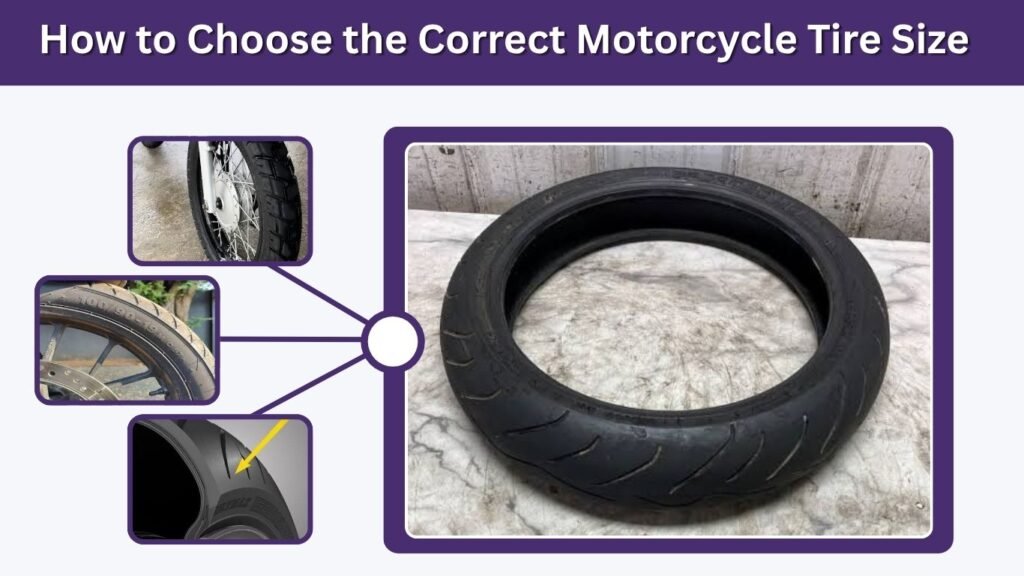
Knowing how to read tire size on a motorcycle is only part of selecting the correct replacement. Tire dimensions must work with the motorcycle’s rim, suspension clearance, load requirements, and intended performance characteristics. Using manufacturer-recommended dimensions helps maintain predictable handling and safety.
Follow the Manufacturer’s Specifications
Before selecting a new motorcycle tire, verify:
- Recommended front tire size
- Recommended rear tire size
- Rim diameter
- Load index
- Speed rating
- Tire construction requirements
- Recommended tire pressure
The owner’s manual is usually the best starting point.
Avoid Oversizing Without Proper Research
Installing a wider tire may seem like an easy way to change appearance or increase grip, but it can alter the tire’s shape when mounted on the original rim.
An incorrectly sized tire may affect steering response, cornering behavior, suspension clearance, and stability.
Match the Tire to Your Riding Style
After confirming the correct size, choose a tire category suited to how you ride.
Street motorcycles, sport bikes, touring motorcycles, adventure bikes, cruisers, and off-road motorcycles use different tread compounds and designs. Size compatibility should come first, followed by the appropriate tire type.
Common Mistakes When Reading Motorcycle Tire Sizes
Motorcycle tire markings contain several measurements within a small space, making misinterpretation easy. The most common mistakes involve confusing width with wheel diameter, ignoring the aspect ratio, mixing front and rear sizes, or selecting tires based only on appearance. Understanding the complete specification helps avoid these errors.
Ignoring the Aspect Ratio
A 120/60R17 and a 120/70R17 tire are not identical.
Both are approximately 120 mm wide and fit a 17-inch wheel, but they have different sidewall heights and overall diameters. This difference can affect motorcycle geometry and handling.
Confusing Rim Diameter With Tire Width
Motorcycle tire measurements use both millimeters and inches.
For example:
120/70R17
means:
120 = width in millimeters
70 = aspect ratio percentage
17 = wheel diameter in inches
Keeping these units separate makes tire codes easier to understand.
Assuming Wider Is Always Better
A wider tire does not automatically provide better performance.
If the tire is too wide for the wheel, its intended profile may become distorted. This can make steering slower or change cornering behavior. Use sizes approved for your motorcycle unless a qualified professional recommends a properly engineered change.
FAQs
How do I read a motorcycle tire size?
A code such as 120/70 ZR17 58W can be divided into sections. The 120 represents tire width in millimeters, 70 is the aspect ratio, Z indicates a high-speed category, R means radial construction, 17 is the wheel diameter, 58 is the load index, and W is the speed rating.
What does 120/70R17 mean on a motorcycle tire?
The number 120 indicates an approximate tire width of 120 millimeters. The 70 means the sidewall height is approximately 70% of the tire width. R indicates radial construction, while 17 means the tire is designed to fit a wheel measuring 17 inches in diameter.
Where can I find my motorcycle’s correct tire size?
You can usually find the tire size printed directly on the tire sidewall. However, the motorcycle owner’s manual or manufacturer information is a better source for confirming the recommended front and rear dimensions, load ratings, speed ratings, and tire pressures before purchasing replacement motorcycle tires.
Can I put a wider tire on my motorcycle?
A slightly different tire size may sometimes be possible, but a wider tire can alter the tire profile, steering response, clearance, and overall motorcycle handling. It should also match the rim width correctly. Check manufacturer-approved sizes or speak with a qualified motorcycle tire professional before changing from the original specification.
Are front and rear motorcycle tire sizes the same?
Usually not. Most motorcycles use a narrower front tire and a wider rear tire because the two wheels perform different jobs. The front tire plays a major role in steering and braking, while the rear manages power delivery and significant load. Always check each tire specification separately.