
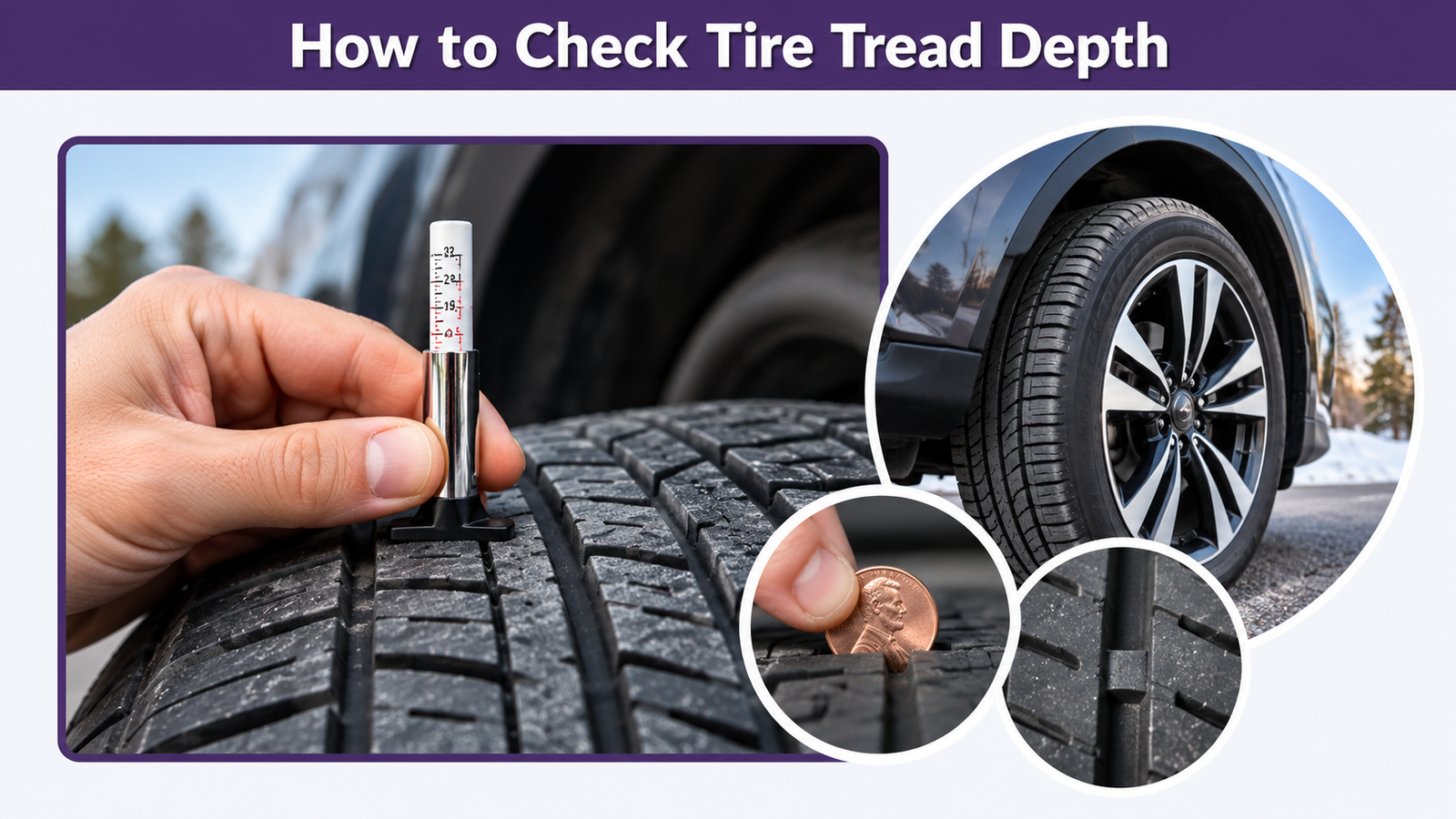
Checking your tire tread depth is an important part of vehicle maintenance that helps improve traction, braking performance, and driving safety. Worn-out tires can make driving dangerous, especially on wet or slippery roads. Fortunately, you can measure tire tread depth at home using simple tools such as a penny, quarter, or tread depth gauge. Understanding how to check tire tread depth also helps you determine when your tires need replacing. This guide explains four easy methods, recommended tread depth levels, and warning signs of excessive tire wear.
What Is Tire Tread Depth and Why Does It Matter?
Tire tread depth refers to the vertical distance between the top of a tire’s tread and the bottom of its main grooves. These grooves help channel water away from the tire’s contact area, improving traction on wet roads.
Tread depth is commonly measured in 32nds of an inch or millimeters. Most new passenger-car tires have approximately 9/32 to 11/32 inches of tread depth, although measurements vary by tire model.
Adequate tread depth provides several important benefits:
- Better traction: Helps tires maintain contact with the road.
- Improved braking: Supports reliable stopping, especially in wet conditions.
- Reduced hydroplaning risk: Allows water to escape through tread grooves.
- Improved handling: Helps maintain steering control during turns.
- Safer driving: Reduces risks associated with excessively worn tires.
How to Check Tire Tread Depth: 4 Easy Methods
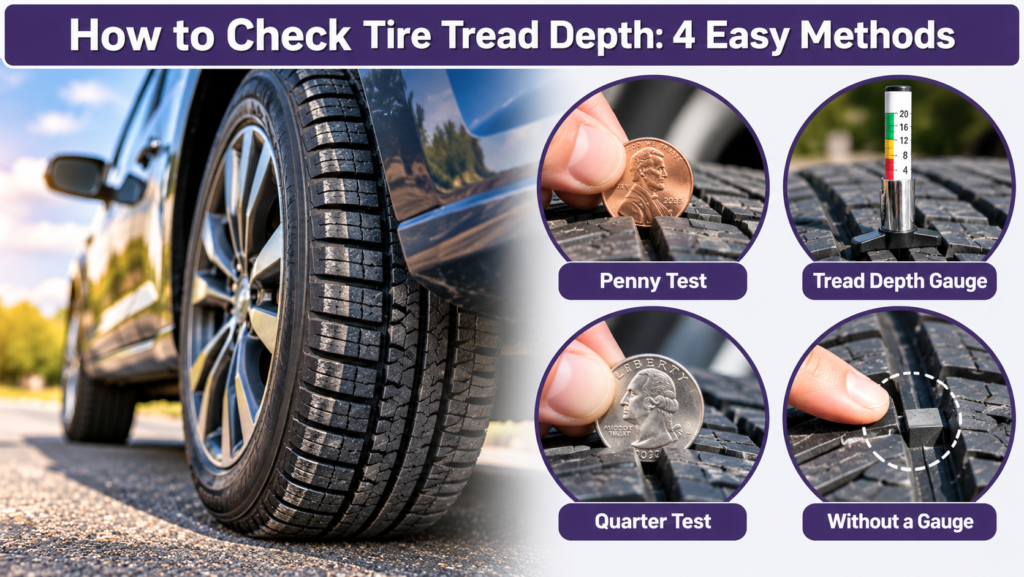
There are several ways to measure tire tread depth without visiting a mechanic. Some methods provide quick estimates, while others offer precise measurements.
Here are four effective methods you can use at home.
1. How to Check Tire Tread Depth With a Penny
The penny test is one of the easiest ways to determine whether your tires have reached the minimum tread depth. It requires only a U.S. penny and takes a few seconds.
Steps to perform the penny test:
- Park your vehicle on a flat surface and engage the parking brake.
- Take a U.S. penny featuring Abraham Lincoln.
- Hold the penny with Lincoln’s head facing downward.
- Insert the penny into a main tire tread groove.
- Check whether the top of Lincoln’s head is visible.
- Repeat the test at several locations across the tire.
Understanding the results:
If part of Lincoln’s head is hidden by the tread, the depth is above approximately 2/32 inch at that location.
If you can see the top of his head, the tire has reached the replacement threshold.
The penny test is convenient, but it cannot provide an exact tread depth measurement.
2. How to Measure Tire Tread Depth With a Gauge
A tire tread depth gauge is the most accurate and practical method for measuring the remaining tread depth at home.
These inexpensive tools are available in analog, digital, and color-coded designs.
Steps to use a tread depth gauge:
- Purchase a tire tread depth gauge from an automotive store.
- Position the gauge on a clean main tread groove.
- Insert its measuring probe until it touches the bottom of the groove.
- Keep the gauge’s base flat against the surrounding tread blocks.
- Read the measurement in millimeters or 32nds of an inch.
- Repeat at the inner, middle, and outer tread areas.
A gauge helps identify small differences in tread depth that might not be visible during a regular inspection.
For reliable results, measure several positions around each tire and record the lowest reading.
3. How to Check Tire Tread Depth With a Quarter
The quarter test is another simple technique for checking tire wear. Unlike the penny test, it helps identify when the tread approaches approximately 4/32 inch.
This measurement is particularly useful for drivers who regularly travel on wet roads.
Steps to perform the quarter test:
- Take a U.S. quarter featuring George Washington.
- Position the coin with Washington’s head facing downward.
- Insert the quarter into a main tire tread groove.
- Observe whether the tread covers the top of Washington’s head.
- Repeat the process across multiple sections of the tire.
If the tread covers part of Washington’s head, the depth is generally above approximately 4/32 inch.
If the entire head is visible, the tire is approaching or below this threshold.
At 4/32 inch, consider planning a replacement, particularly for frequent driving in rainy weather.
4. How to Check Tire Tread Depth Without a Gauge
You can also check your tire tread depth by inspecting the built-in tread wear indicators.
Most passenger-car tires feature small raised rubber bars inside their main tread grooves. These indicators become more noticeable as the tire wears down.
To inspect them, locate the horizontal rubber bars inside the grooves and compare their height with the surrounding tread surface.
If the tread surface becomes level with these bars, the tire has typically reached approximately 2/32 inch.
This method requires no additional equipment and provides a useful visual warning when tire replacement becomes necessary.
However, tread wear indicators cannot measure intermediate tread depths accurately.
Tire Tread Depth Chart: What Is a Safe Measurement?
Understanding tire tread measurements helps determine whether your tires are suitable for continued driving.
The following chart provides general guidance for passenger-car tires.
| Tread Depth | Approx. mm | Condition |
|---|---|---|
| 10/32 inch | 7.9 mm | Typical new-tire depth |
| 8/32 inch | 6.4 mm | Good tread remaining |
| 6/32 inch | 4.8 mm | Moderate wear |
| 4/32 inch | 3.2 mm | Consider replacement for wet driving |
| 3/32 inch | 2.4 mm | Very worn; replace soon |
| 2/32 inch | 1.6 mm | Replace immediately |
| Below 2/32 inch | Below 1.6 mm | Unsafe tread depth |
These measurements are general guidelines rather than guarantees of safety. Tire type, weather conditions, damage, and local regulations also influence replacement decisions.
For winter driving, deeper tread is often necessary to maintain adequate snow traction.
How Often Should You Check Tire Tread Depth?
Checking tire tread depth regularly helps identify wear before it creates serious safety problems. Drivers should inspect their tires at least once a month and before long road trips.
Tires can wear at different rates depending on driving habits, road conditions, inflation pressure, and vehicle alignment.
For example, frequent highway driving, aggressive braking, and improper tire pressure can accelerate tread wear.
Regular checks also help identify developing problems before they affect driving performance.
The NHTSA recommends checking tire tread monthly alongside tire pressure inspections.
Signs Your Tire Tread Is Too Low
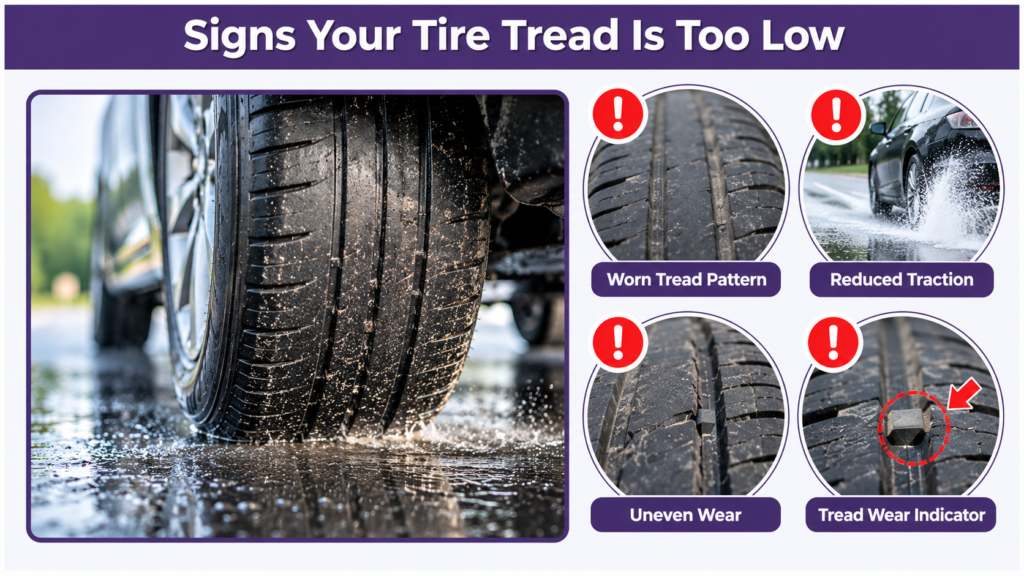
Low tread depth is not always obvious from a distance. However, several warning signs may indicate that your tires are worn or need professional inspection.
Uneven Tire Tread Wear
Uneven tread wear occurs when one section of the tire wears faster than another. Excessive center wear may indicate overinflation, while wear along both shoulders often suggests underinflation.
One-sided wear can indicate wheel alignment or suspension problems.
Reduced Traction on Wet Roads
Worn tires have shallower grooves, making it harder to channel water away from the contact patch.
As a result, your vehicle may experience reduced traction, longer braking distances, and an increased risk of hydroplaning during heavy rain.
Visible Tread Wear Bars
Tread wear bars are designed to indicate when a tire reaches its minimum usable tread depth.
If the surrounding tread is level with these bars, the tire should be replaced rather than continuing regular driving.
Cracks, Bulges, or Exposed Cords
Tire damage can make replacement necessary even when adequate tread remains.
Visible sidewall bulges, significant cuts, exposed cords, and deep cracking require professional attention. These problems may indicate structural damage that cannot be assessed through tread measurements alone.
When Should You Replace Your Tires?
You should replace a tire when its tread reaches 2/32 inch, the minimum commonly used for passenger-car tires in the United States. Local legal requirements can differ.
However, waiting until this measurement is not always the safest approach.
For vehicles regularly driven on wet roads, replacing tires around 4/32 inch may provide an additional safety margin.
Winter tires may require replacement at even greater tread depths when their snow performance becomes inadequate.
Tires should also be inspected for age-related deterioration, unusual vibration, structural damage, and uneven wear.
A tire professional can help determine whether replacement is necessary based on its overall condition rather than tread depth alone.
Frequently Asked Questions
1. How do you check tire tread depth at home?
You can check tire tread depth at home using a penny, quarter, or tread depth gauge. Insert the tool into the main tread grooves and check several locations. A depth gauge provides the most accurate measurement.
2. What is the minimum safe tire tread depth?
The commonly used minimum tread depth for U.S. passenger-car tires is 2/32 inch, approximately 1.6 millimeters. However, wet-weather traction declines before this limit, so earlier replacement may be advisable depending on driving conditions.
3. How do you check tire tread depth without a penny?
You can use a tread depth gauge or inspect the built-in tread wear indicators. A quarter can also provide a useful approximate measurement. A dedicated gauge is the most reliable option for obtaining precise numerical readings.
4. Is 4/32 tire tread depth still good?
A tire with 4/32 inch of tread has more than the typical legal minimum, but its wet-weather performance may be significantly reduced. Drivers frequently encountering rain should consider replacing their tires at this depth.
5. How often should tire tread depth be measured?
Tire tread depth should be checked at least once a month and before extended road trips. Inspect all four tires and measure several areas because uneven wear can cause tread depth to vary across the surface.