
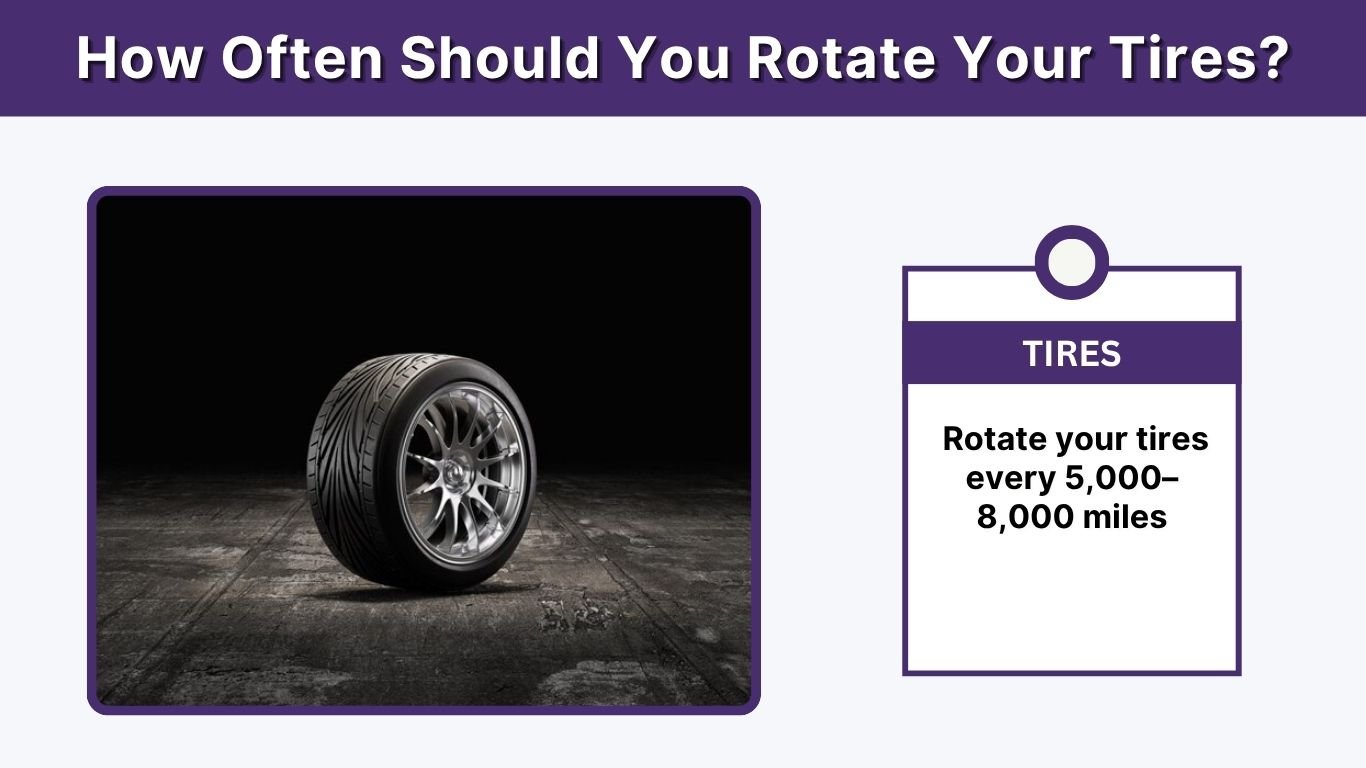
You should generally rotate your tires every 5,000–8,000 miles (8,000–13,000 km), unless your vehicle manufacturer specifies a different interval. For many drivers, this works out to approximately every six months or during every other oil change. Regular rotation distributes tread wear more evenly among all four tires, helping preserve traction, handling, fuel efficiency, and tire life. All-wheel-drive vehicles, electric cars, performance models, and trucks may need more frequent service because their tires can wear differently. Always check the owner’s manual before choosing a rotation schedule or pattern.
How Often Should You Get Your Tires Rotated?
The general recommendation is every 5,000–8,000 miles. Rotating sooner may be appropriate when visible tread differences develop between the front and rear tires.
NHTSA recommends following the vehicle owner’s manual and, when rotation is advised, using the 5,000–8,000-mile range or rotating sooner if irregular wear appears. Michelin recommends scheduling rotation about every 6,000–8,000 miles or around routine oil-change service.
| Vehicle type | Practical rotation interval |
| Most passenger cars | Every 5,000–8,000 miles |
| Front-wheel drive | Usually every 5,000–8,000 miles |
| Rear-wheel drive | Usually every 5,000–8,000 miles |
| AWD or 4WD | Follow the manual closely; often near the lower end |
| Electric vehicle | Follow the manufacturer’s interval |
| Truck or SUV | Usually every 5,000–8,000 miles |
| Severe driving conditions | Inspect and rotate more frequently |
The exact interval should come from the vehicle’s maintenance schedule. Tire construction, drivetrain, wheel size, driving style, road conditions, and load can all affect wear.
How Often Should You Rotate Tires in Months?
For an average driver, rotating every six months is a convenient schedule. However, mileage and tread condition are more important than simply waiting for a certain number of months.
A driver covering 12,000 miles annually may reach a 6,000-mile interval every six months. Someone who drives long distances could reach that point much sooner. A low-mileage driver may pair tire rotation with a six- or twelve-month inspection, depending on the owner’s manual.
Check tire pressure and condition monthly, even when the car is driven infrequently. Tires naturally lose pressure, and irregular wear may develop before the next scheduled rotation.
Why Tire Rotation Is Important
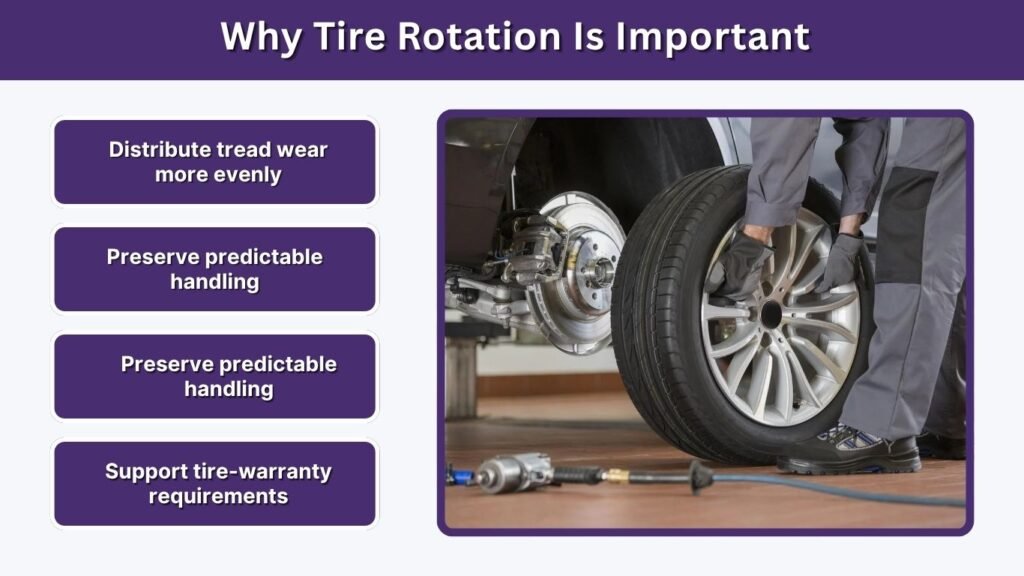
Tires do not usually wear at identical rates. Steering, acceleration, braking, vehicle weight, drivetrain design, and wheel alignment place different demands on each position.
On a front-wheel-drive vehicle, the front tires manage steering, much of the braking, and engine power. They commonly wear faster than the rear tires. Rear-wheel-drive vehicles place more acceleration force on the rear tires, although the front pair still carries the steering load.
Regular rotation can help:
- Distribute tread wear more evenly
- Extend the useful life of the tire set
- Maintain more consistent traction
- Preserve predictable handling
- Reduce vibration caused by irregular tread wear
- Support tire-warranty requirements
- Delay the need for premature replacement
NHTSA notes that rotation helps reduce irregular wear and may help tires last longer while maintaining their fuel efficiency.
How Often Should You Rotate AWD Tires?
AWD tires should usually be rotated near the lower end of the recommended interval, but the owner’s manual remains the final authority.
An all-wheel-drive system depends on all four wheels working together. Significant differences in tread depth can create differences in tire circumference and rotational speed. Maintaining similar tread depth across the set is therefore particularly important.
Michelin notes that AWD and 4WD vehicles generally require more frequent rotation to preserve uniform tread depth. Subaru, for example, recommends routine rotation every 6,000 miles, while directing owners to the applicable maintenance booklet for model-specific instructions.
Measure tread depth in several grooves and compare all four tires. Do not wait for one pair to become visibly worn before arranging service.
How Often Should You Rotate EV Tires?
Electric vehicles should be rotated according to their manufacturer’s schedule. Battery weight and immediate motor torque may contribute to faster or less uniform wear on some models.
Tesla currently recommends rotating Model 3 tires every 6,250 miles (10,000 km) or when the tread-depth difference reaches 2/32 inch (1.5 mm) or more, whichever occurs first. Other EV manufacturers may specify different intervals.
Inspect EV tires regularly if the vehicle is driven aggressively, frequently carries heavy loads, or produces noticeably faster rear- or front-tire wear.
Tire-Rotation Patterns
The correct pattern depends on the drivetrain and tire design.
Front-Wheel-Drive Pattern
The front tires normally move straight to the rear. The rear tires cross to the opposite sides at the front.
Rear-Wheel-Drive and 4WD Pattern
The rear tires usually move straight forward. The front tires cross to opposite sides at the rear.
X-Pattern
Each tire moves diagonally to the opposite corner. This method may be suitable for certain vehicles with four same-size, nondirectional tires.
Side-to-Side Pattern
The tires switch between the left and right sides without moving between axles. This may be used on vehicles with different front and rear tire sizes when the tires are nondirectional.
Always verify the proper pattern in the owner’s manual. NHTSA cautions that some vehicles should not have their tires rotated, particularly when the front and rear tires are different sizes.
Directional and Staggered Tires
Not every set can follow a standard cross pattern.
Directional Tires
Directional tires are designed to rotate in one direction. An arrow on the sidewall shows the correct direction of travel.
When all four directional tires are the same size, they are normally moved from front to rear on the same side. Moving them to the opposite side would require dismounting them from their wheels and reinstalling them in the correct direction.
Staggered Tires
A staggered setup uses different tire sizes on the front and rear axles. These tires cannot normally move between axles.
Nondirectional staggered tires may sometimes be switched from side to side. Directional staggered tires may have few or no practical rotation options. Consult the vehicle and tire manufacturer before moving them.
Should Tires Be Balanced Every Time They Are Rotated?
Tire rotation and balancing are separate services. Rotation changes each tire’s location, while balancing corrects unequal weight distribution in the wheel-and-tire assembly.
You do not necessarily need balancing during every rotation when the car drives smoothly and the tires show no related problems. Balancing should be checked when:
- The steering wheel vibrates
- The seat or floor shakes at certain speeds
- A tire has been repaired
- New tires are installed
- A wheel weight is missing
- Uneven or cupped wear develops
NHTSA states that new tires should be balanced when installed and identifies rotation, balancing, and alignment as useful tire-maintenance practices.
Do You Need an Alignment With Every Rotation?
No. Wheel alignment is not automatically required every time the tires are rotated.
Alignment adjusts the wheel angles so the tires meet the road correctly. It should be checked when the vehicle:
- Pulls to one side
- Has an off-center steering wheel
- Develops rapid inner- or outer-edge wear
- Handles differently after hitting a pothole or curb
- Has suspension or steering work performed
Rotation cannot repair wear caused by incorrect alignment. NHTSA notes that alignment can maximize tire life and help correct a vehicle that veers on a straight, level road.
Signs You Should Rotate Tires Early
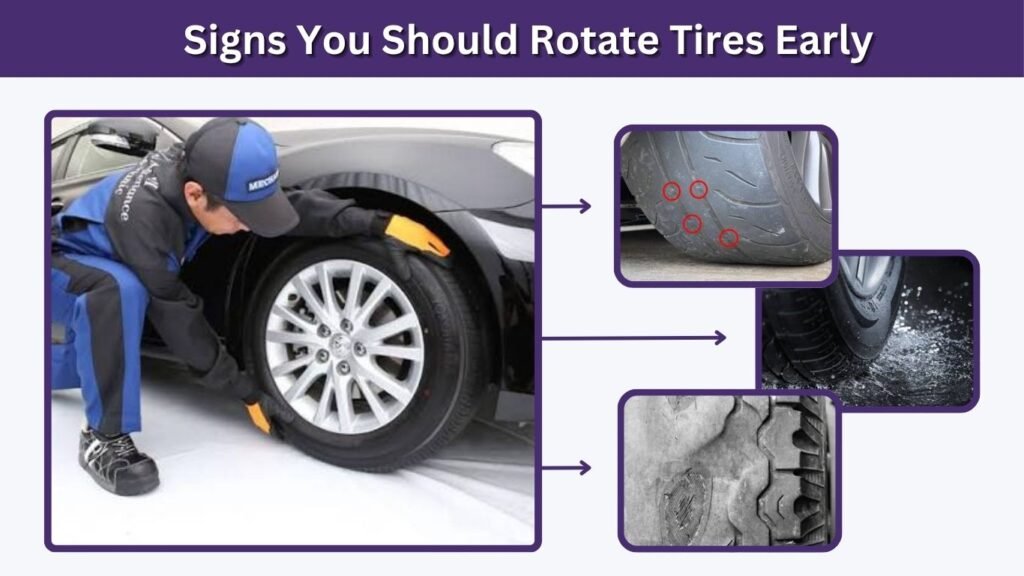
Do not wait for the scheduled mileage when the tires are already wearing unevenly. Arrange an inspection when you notice:
- Front tires wearing faster than rear tires
- Different tread depths across the four tires
- Feathering, cupping, or uneven shoulder wear
- Increased road noise
- Vibration at normal driving speeds
- Reduced wet-road traction
- A tread-depth difference on an AWD vehicle
Uneven wear may also indicate incorrect inflation, worn suspension parts, poor wheel balance, or misalignment. Rotation can distribute normal wear, but it cannot correct an underlying mechanical problem.
Can You Rotate New Tires Immediately?
New tires do not need immediate rotation, but the schedule begins as soon as they are installed. Record the installation mileage and rotate them when they reach the manufacturer’s specified interval.
The first rotation is important because early wear patterns can become established quickly. Some mileage warranties also require documented rotations at specified intervals, so keep invoices or maintenance records.
When replacing only two tires, many tire manufacturers recommend fitting the new pair to the rear axle to support wet-road stability. Ask the installer to confirm the correct placement and future rotation options for your vehicle.
FAQs
Is rotating tires every 10,000 miles enough?
Ten thousand miles may be longer than the interval recommended for many vehicles. NHTSA’s general range is 5,000–8,000 miles when the manufacturer recommends rotation. Follow your owner’s manual, especially for AWD vehicles and tires covered by a mileage warranty.
Can I rotate my tires every oil change?
Yes, provided the oil-change interval aligns with the tire schedule. Rotation every 5,000–8,000 miles works well for many vehicles. Cars with extended oil-change intervals may require tire rotation before the next oil service.
What happens if you never rotate your tires?
One axle may wear considerably faster than the other, shortening the life of the set and reducing consistent traction. Irregular wear can also increase road noise and make it necessary to replace some tires prematurely.
How long does a tire rotation take?
A professional rotation commonly takes approximately 20–45 minutes, although service time varies by workshop, wheel design, inspection needs, and whether balancing or other maintenance is performed.
Should all four tires be replaced at the same time?
Replacing all four is often preferred for AWD vehicles because closely matched tread depth and circumference are important. Other vehicles may permit replacing two, but the new pair is generally installed on the rear. Follow the vehicle and tire manufacturer’s guidance.